How to Find Property Liens: A Guide for Real Estate Investors
Learn how to find property liens and uncover distressed deals. Our guide covers county records, title reports, and automated tools for savvy investors.
By James Le
To find any lien on a property, you have to dig into public records. This search happens at the county level, and you’ll be spending your time sifting through documents from the County Recorder of Deeds, the Tax Assessor, and various local court dockets. The process really boils down to grabbing a few key property identifiers—like the Assessor's Parcel Number (APN)—and then cross-referencing that info across different government offices to see what claims pop up.
Your Guide to Finding Hidden Property Liens
Finding property liens isn’t just a tedious box-ticking exercise. For savvy operators, it's a strategic advantage, a way to unlock some truly exclusive, off-market deals.
Imagine finding a high-equity property completely bogged down by a solvable tax lien before it ever hits Zillow. This guide will show you how to turn that kind of scenario into a repeatable, scalable part of your business.
First things first, you need to understand the landscape. Liens are simply claims on a property, acting as security for a debt. They come in several common forms, and every real estate operator should know them by heart.
Key Lien Types to Watch For
To get good at this, you have to know the various property lien types. Each one tells a different story about the owner's situation and, more importantly, points to a unique investment opportunity.
- Tax Liens: These are filed by the government—local, state, or federal—for unpaid taxes. They're often the most straightforward to find and act upon. For a much deeper dive, check out our detailed guide on tax lien investing.
- Mechanic's Liens: A contractor or supplier who didn't get paid for work on the property can file one of these. It’s a huge red flag that the owner is under financial strain.
- Judgment Liens: This lien is the result of a lawsuit. When a court awards a monetary judgment to a creditor, that creditor can then attach it to the debtor's real estate.
- HOA Liens: Homeowners' associations can file these for unpaid dues or fines. Depending on the state, these can sometimes jump the line and take priority over other liens.
Uncovering these liens is the secret to building a predictable pipeline of motivated sellers. These aren't just legal claims; they're powerful indicators of distress that let you get ahead of the competition and lock down properties others don't even know exist.
And the opportunities are only growing. In the first half of 2025 alone, U.S. foreclosure filings hit 187,659 properties. That’s a 5.8% jump from the same period in 2024. This surge just highlights the goldmine of opportunities tied to foreclosures, tax delinquencies, and court judgments. If you want to see the numbers for yourself, you can dig into the latest foreclosure statistics for 2025.
Mastering Manual Searches in County Public Records
The most reliable way to find property liens is to go directly to the source. This is where the real digging begins—moving beyond aggregated data and into the official files where liens are born and recorded. Mastering the manual search process at the county level gives you a powerful advantage, often revealing information before it hits larger databases.
Your search will center on a few key government offices, each holding a different piece of the property puzzle. Think of it as a cross-referencing mission. You'll take your property identifiers—like the owner's legal name and the Assessor's Parcel Number (APN)—and check them against records in multiple departments to build a complete picture.
The process of identifying, searching, and verifying information is crucial for any successful lien discovery effort.
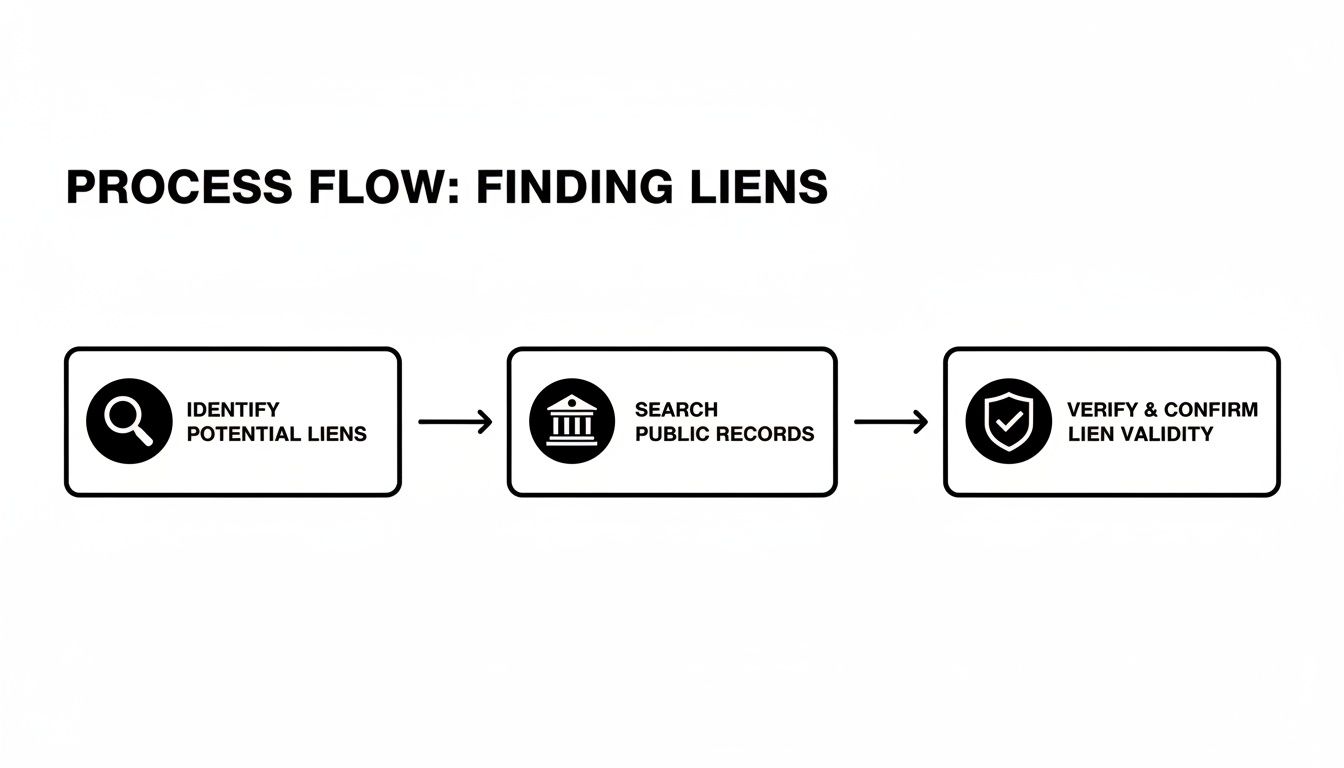
This workflow isn't just a diagram; it's a mental model. Finding a potential lien is only the beginning. Verification is what protects your investment.
To effectively navigate this landscape, it helps to know which records live where. Each office serves a distinct purpose, and understanding their roles is key to an efficient search.
Key Public Records for Lien Searches
Here’s a quick breakdown of the essential public record sources, what they contain, and where you'll typically find them.
| Record Source | Types of Liens Found | Primary Access Point |
|---|---|---|
| Recorder of Deeds | Mortgages, Deeds of Trust, Judgment Liens, Mechanic's Liens, Lis Pendens | County Recorder or Clerk's Office (in-person or online portal) |
| Tax Assessor/Collector | Delinquent Property Tax Liens (Ad Valorem Taxes), Special Assessment Liens | County Tax Office website or physical office |
| Local Court System | Potential Judgment Liens (from pending lawsuits), Probate/Estate Liens, Foreclosure Filings | County or District Court Clerk's Office (online dockets or physical records) |
This table acts as your roadmap, guiding you to the right department for the specific information you need to uncover.
Starting at The County Recorder of Deeds
The County Recorder's Office (sometimes called the County Clerk) is your first and most important stop. This office is the official library for all documents affecting real estate ownership in the county. Mortgages, deeds of trust, and judgment liens are all filed here.
When you're searching these records, you're looking for any "encumbrance" or claim recorded against the property's title. For instance, a judgment lien from a civil lawsuit will appear here after the court awards a creditor a monetary judgment. The creditor then records that judgment with the county to attach it to the debtor's real estate.
For a deeper dive into how these records are organized and accessed, our guide on a county property records search provides valuable context.
Key documents to hunt for include:
- Mortgages and Deeds of Trust: Shows who has a primary financial stake in the property.
- Abstracts of Judgment: Hard evidence of a court-ordered debt attached to the property.
- Lis Pendens: A formal notice that a lawsuit involving the property is pending, which could result in a future lien.
Checking with The County Tax Assessor and Collector
Next up, you have to investigate the property's tax status. Unpaid property taxes create some of the most common—and powerful—types of liens out there. This search usually involves two related but distinct offices.
The County Tax Assessor determines the property's value for tax purposes. The County Tax Collector is responsible for actually billing and collecting those taxes. Thankfully, many counties now have online portals where you can search by APN or address to see the property's entire tax history, including any delinquencies.
If a property is behind on taxes, a lien is automatically placed on it, and it can eventually be sold at a tax sale.
Remember, a tax lien often takes priority over other liens, including a first mortgage. This "super-priority" status makes identifying delinquent taxes a non-negotiable step in your due diligence.
Sifting Through Local Court Records
Finally, your search has to extend to local court records. While judgment liens are ultimately filed at the Recorder's office, the lawsuits that create them originate in the court system. Searching court dockets can give you an early warning about potential liens long before they are officially recorded against a property.
Look through the civil court dockets for lawsuits filed against the property owner. A significant lawsuit could easily become a judgment lien down the road. This proactive step helps you spot financial distress signals that other investors might miss, giving you a critical head start.
Uncovering Liens Beyond Standard County Searches
While the county recorder and tax assessor offices are your bread and butter, the really motivated sellers—the ones who lead to the best deals—are often hidden in plain sight, buried under problems most investors never bother to look for. To get a real edge, you have to dig deeper than the standard property record search. You have to go where the problems are.
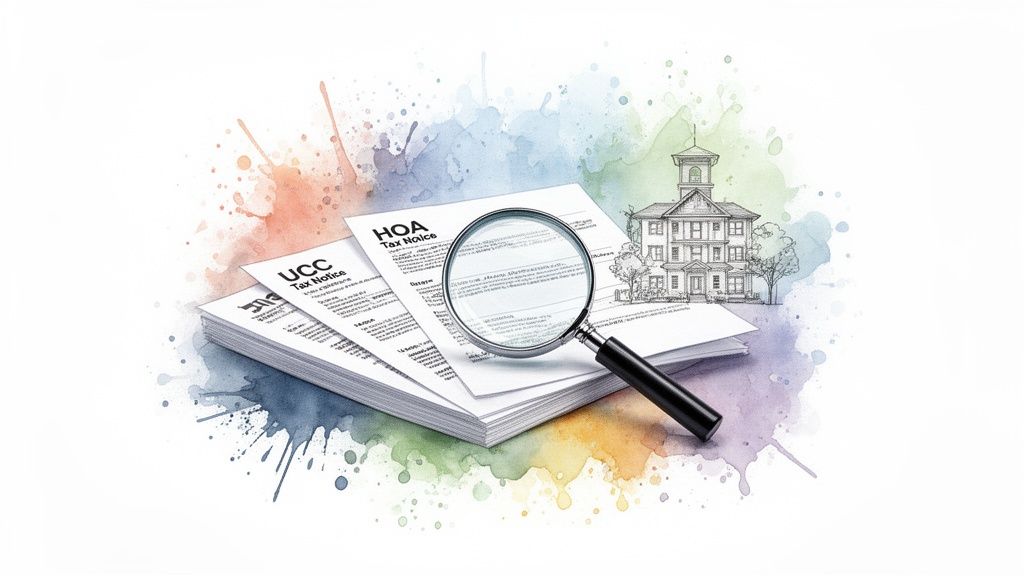
These secondary lien types, from UCC filings to pesky municipal violations, tell a much richer story about a property owner's financial distress. Learning to sniff them out is what separates the weekend warriors from the professional operators who build scalable deal pipelines.
Digging into Uniform Commercial Code Filings
Your search shouldn't stop at the dirt. Uniform Commercial Code (UCC) filings are claims against personal property, not the land itself, but they can throw a major wrench in a deal. You'll typically find these filed with the Secretary of State, not the county recorder.
Think about it: a business owner might take out a loan using his restaurant's kitchen equipment as collateral. If that equipment is crucial to the property's value, that UCC lien becomes your problem. More common for residential properties, a homeowner might have financed a new HVAC system or a set of solar panels, leading to a UCC filing against those "fixtures."
These liens represent another layer of debt that has to be cleared. They won't pop up in a standard title search, making a dedicated UCC search an essential step for any serious due diligence.
The Critical Importance of HOA and Condo Association Liens
Homeowners' association (HOA) and condo association liens are some of the most powerful—and most frequently missed—encumbrances out there. The tricky part is they aren't always centrally recorded like a tax lien. Often, the only way to find them is to pick up the phone and call the association's management company directly.
In many states, these liens have what's called "super-lien" status. This means they can jump to the front of the line in a foreclosure, taking priority over almost everything else, even a first mortgage. The risk here is massive, but so is the opportunity.
HOA liens exploded in 'super-lien' states in 2025, where unpaid dues take priority over mortgages, creating hidden risks and opportunities worth millions for those who search county records diligently. Benutech data showed these secured liens rising at alarming rates in states like Florida, Nevada, and Texas, often leading to foreclosures when owners default—Florida alone had 15,198 foreclosure starts in H1 2025. You can explore more data on the impact of HOA liens in super-lien states.
Simply put, ignoring a potential HOA lien is not an option. It could completely wipe out your equity or even trigger a foreclosure you never saw coming.
Spotting Municipal and Code Violation Liens
Finally, don't forget about the local municipality. Cities and towns can slap liens on a property for all sorts of reasons that have nothing to do with property taxes. For fix-and-flip investors, these are especially critical to uncover.
These "nuisance" liens pop up for a variety of reasons:
- Unpaid Utilities: Delinquent water, sewer, or trash collection bills can easily turn into a lien.
- Code Violations: Fines for overgrown grass, an unsafe porch, or other ordinance violations can stack up quickly and become a formal claim against the title.
- Special Assessments: These are liens for public projects that benefit the property, like new sidewalks or sewer lines the owner was billed for.
Finding these usually means making a direct inquiry to the city's building department, code enforcement office, or utility provider. They represent solvable problems that can create incredible leverage when you're at the negotiating table.
How to Verify Your Findings with Professional Services
So, your own digging turned up a potential lien. That's a great start, but don't pop the champagne just yet. A recorded document is really just a breadcrumb, not the whole story.
Now comes the most critical part: verification. You have to confirm the lien is accurate, figure out the current outstanding amount, and—most importantly—determine its priority against other claims. This is where you shift from investigator to risk manager, and professional services are your best friend.
Relying only on your own research is like using WebMD to diagnose a serious illness. You might be right, but the stakes are way too high to leave it to chance. Professional verification is what protects your capital and makes sure you're not walking into a financial minefield.
The Gold Standard: A Professional Title Search
The single most reliable way to get the ground truth is to order a professional title search from a reputable title company or a real estate attorney. This isn't just about double-checking your work; it's an insured process that gives you a definitive, legally-backed statement on the property's title status.
A company's title examiner will perform an exhaustive search of public records, digging far deeper than what you or I can typically access online. They're looking for everything.
The result is a document called a Preliminary Title Report (or just a "prelim"). This report is your roadmap to the property’s entire financial and legal history.
Learning to read a prelim is a crucial skill. It lays out:
- The chain of title, showing the complete history of ownership transfers.
- All recorded encumbrances—mortgages, easements, and, of course, the liens you found (plus any you might have missed).
- The priority of these claims, which dictates who gets paid first when the property is sold.
A professional title report transforms your research from an educated guess into an insurable fact. That small upfront cost can save you from a catastrophic mistake, like discovering a surprise senior lien after you’ve already sunk a ton of capital into a deal.
Using Paid Data Services as a Smart Middle Ground
A full title search is non-negotiable before closing a deal. But ordering one for every single property in your initial due diligence phase would get expensive fast. This is where paid data services come in as a brilliant strategic step.
These platforms pull together massive amounts of public records and present the data in a clean, easy-to-scan format. They can help you quickly confirm details you've found, connect property owners to other potential debts, and sometimes even provide updated contact info.
While they are absolutely not a substitute for an insured title report, these services are fantastic for quickly qualifying your best leads before you commit more time and money. Some of the best skip tracing services for real estate also provide powerful property data that’s incredibly useful during this verification stage.
Think of your workflow in tiers. Use your manual research to build a pipeline of interesting leads. Then, leverage paid data services to quickly vet and filter that list down to the real opportunities. Finally, before any serious money changes hands, order that professional title search to get the official, insured green light.
Want to Scale Your Pipeline? It's Time to Automate Your Lien Search.
Doing a manual lien search works fine when you're chasing a single deal. But if you're trying to build a real, high-volume investment pipeline, that approach falls apart fast. The hours you spend digging through one clunky county website after another quickly become your biggest bottleneck.
The answer isn't to work harder—it's to stop doing the machine's work.
Modern tools can systematically pull data from the exact same sources you're searching by hand: deeds, tax records, court dockets, and code violations. The critical difference? Automated systems do it in real-time, across multiple counties at once, and drop a curated list of opportunities right into your lap. This is how you shift from being a data entry clerk to a dealmaker.

From Raw Data to Qualified Leads
The real magic of automation isn't just about grabbing data; it's about turning that firehose of raw information into actionable intelligence. Instead of getting a messy list of every property with any kind of lien, you can build a system that automatically filters and prioritizes leads based on your specific investment strategy.
Think about it. You could set up a workflow that instantly flags properties matching your perfect profile:
- A specific lien type, like a tax or mechanic's lien.
- A minimum equity threshold you're comfortable with.
- Located only within your target zip codes.
- No other major clouds on the title.
This kind of automated filtering cuts out countless hours of manual vetting. It ensures you only spend your precious time on properties with the highest potential for a profitable deal. You get to focus your energy on the most promising leads first, giving you a massive head start on your competition.
The Real Payoff: Getting to Motivated Sellers First
In this business, speed is everything. An automated system monitoring public records 24/7 means you're one of the very first to know when a new lien gets filed. This puts you in a position to reach out to a distressed property owner right at the beginning of their financial trouble—often before they've been buried in postcards and cold calls from every other investor in town.
Property tax liens, in particular, have become a powerful leading indicator of distress. With national delinquency rates on non-escrowed loans recently hitting 5.1% year-to-date, these tax issues signal financial cracks long before a mortgage default ever shows up. This is precisely why savvy investors are prioritizing tax records, a trend that's only grown stronger as property taxes have surged 27% nationally since 2019. You can dig deeper into the latest 2025 property tax delinquency trends to see where things are headed.
The whole point of automation is to build a predictable, repeatable flow of qualified leads. When you know exactly where your next ten deals are coming from, you can stop prospecting and start doing what you do best—negotiating and closing.
Closing the Loop: Integrating Lien Data into Your CRM
The final piece of this automated puzzle is plugging all this great data directly into your Customer Relationship Management (CRM) system. It’s simple: when a new lead matching your criteria pops up, the system should automatically create a new record in your CRM. All the key details—property info, lien specifics, and owner contact data—should be right there.
From that point, you can trigger your entire follow-up machine. Maybe it's an initial mailer that goes out automatically. Perhaps the lead gets assigned to a team member for a call. Or maybe the owner gets enrolled in a targeted digital marketing campaign. This seamless integration turns raw lien data into actual appointments, creating a powerful engine that drives your entire operation forward.
A Few Lingering Questions About Property Liens
Even with a solid game plan, you're bound to run into questions when you start digging for property liens. Let's tackle some of the most common ones that come up for operators and investors in the thick of a search.
How Long Does a Property Lien Stick Around?
This is a classic "it depends" situation. The lifespan of a lien is completely dictated by the type of lien and state law. There's no universal timeline, which is exactly why knowing the local rules of the game is non-negotiable.
A mechanic's lien, for instance, is usually a short-term problem, often lasting just a few months to a year unless the contractor files a lawsuit to foreclose. On the other end of the spectrum, a judgment lien from a lawsuit can haunt a property for 10 years or more. In many states, they're even renewable, stretching out their impact for decades.
Federal tax liens are another beast, typically staying on the books for 10 years from the date they were assessed. Always, always check the "statute of limitations" in your state. You might find a lien in the records that's technically too old to be legally enforceable.
Can I Really Find Property Liens Online for Free?
Yes, you absolutely can find liens online without paying a dime, but your mileage will vary wildly depending on the county. Most county recorder, clerk, and tax assessor offices have some kind of online portal for public records.
These government sites are your first stop, letting you search by owner name, address, or the APN. The catch? The quality is all over the map. Some counties have slick, modern databases that make searching a breeze. Others look like they haven't been updated since 1998 and are a nightmare to navigate.
Free online searches are a fantastic first pass for initial due diligence. But don't bet the farm on them. They might not catch everything, so you'll want to back them up with more thorough methods for any serious deal.
What’s the Difference Between a General and Specific Lien?
The key distinction here is all about what assets the lien can actually grab. Getting this right is critical for understanding a seller's true financial picture and how a lien might blow up your deal.
- A specific lien is laser-focused on one single asset. Think of a mortgage, a mechanic's lien for a roof repair, or a property tax lien. The debt is secured only by that specific house or parcel of land.
- A general lien is the shotgun approach—it attaches to all the property someone owns in that jurisdiction. This includes their house, their car, their boat, you name it. Federal tax liens and major judgment liens are the most common types of general liens.
Once you spot a lien, the next move is figuring out how to deal with it. Knowing how to remove a tax lien from your record is an essential skill for any investor who plans on being in this business for the long haul.
Stop wasting time on bad data and missed opportunities. Tab Tab Labs uses proprietary county-level data and AI-powered automation to fill your pipeline with exclusive, pre-qualified seller appointments. Move from fighting over stale lists to owning your market. Book a free strategy call today.