Automated Real Estate Wholesale Leads Generation System
Discover how to build a scalable system for real estate wholesale leads. Learn to source, prioritize, and convert distressed property owners with AI.
By James Le
Real estate wholesaling is all about finding distressed properties and connecting the motivated folks who own them with cash buyers. Simple enough. But the best leads? They come from exclusive, off-market data scraped directly from county records—a world away from the high-competition national lists everyone else is hammering.
The real goal isn't just to find one deal. It's to build a system that consistently surfaces these sellers before anyone else even knows they exist.
Building Your Off-Market Lead Generation Machine
If you're tired of fighting over the same stale lists every other investor in your market has already called a dozen times, it's time for a change. Predictable growth in wholesaling comes from building a repeatable lead generation machine, not just chasing individual deals.
Think of it as a system that runs in the background, constantly digging up exclusive, high-probability opportunities and filling your calendar with qualified seller appointments. A modern approach skips the generic national databases and plugs directly into proprietary, county-level data. This is where the real gold is hidden.
Core Components of a Modern Lead Engine
To build a system that delivers a steady flow of real estate wholesale leads, you need a few key components working together. The whole point is to automate the tedious, time-consuming stuff so your team can focus on what they do best: building rapport and closing deals.
The essential pieces look something like this:
- Proprietary Data Sourcing: You need a way to pull fresh data from county sources like probates, tax liens, foreclosures, and code violations. These are the distress signals that pop up long before a property hits the MLS. Our guide on off-market real estate really digs into how to find these opportunities.
- Automated Outreach: Once you have the leads, you need multi-channel campaigns using direct mail, SMS, and email to connect with homeowners on whatever channel they actually use.
- AI-Powered Qualification: This is a huge one. Using AI assistants to engage leads the moment they respond, ask the right qualifying questions, and gauge seller motivation—24/7.
- Seamless Integration: Your lead sources need to talk directly to your CRM and calendar. This automates appointment setting and kills manual data entry, which is a massive time-suck.
This shift in strategy is all about creating a predictable pipeline. Instead of wondering where your next deal will come from, you'll have a system designed to generate 15–20 pre-qualified seller appointments every single month.
The Power of Exclusive County-Level Data
Let's be real: in the competitive game of real estate wholesaling, the quality of your leads makes or breaks you. Recent data showed over 300,000 foreclosure filings in the U.S. in a single year, marking a 10% increase from the year before. That trend creates a huge market for wholesalers, and the absolute best way to reach these motivated sellers is by tapping into local county records.
To build an effective off-market machine, you have to identify and use the top marketing lead sources that will actually drive growth. It's about working smarter, not just harder.
The core advantage of building your own system is that you move from a reactive to a proactive model. You are no longer waiting for leads to appear; you are systematically creating them by identifying distress signals at their source. This gives you a critical first-mover advantage that is impossible to achieve with overused, publicly available lists.
Data Source Comparison For Wholesale Leads
Finding motivated sellers means choosing the right pond to fish in. Some sources are packed with competition, while others offer a clearer path to exclusive deals. Here’s a quick breakdown of how traditional data sources stack up against more modern, direct-from-county approaches.
| Data Source | Lead Quality | Competition Level | Scalability |
|---|---|---|---|
| National Lists (e.g., ListSource) | Low to Medium | Very High | High |
| Direct Mail (self-sourced) | Medium to High | Medium | Medium |
| Driving for Dollars | High | Low | Low |
| Direct County Data Scraping | Very High | Very Low | High |
As you can see, pulling data directly from the source gives you a massive edge in both lead quality and competition. While it requires more setup, the payoff in terms of exclusive, high-intent leads is unmatched. This is the foundation of a truly scalable wholesale business.
Sourcing and Prioritizing High-Probability Distress Signals
The most successful wholesalers I know share a powerful secret: not all leads are created equal. Getting ahead in this business isn't about casting a wide net; it’s about a laser focus on sellers who have the highest motivation to act now. This means digging deeper than the generic, over-fished lists and learning to spot, weigh, and combine specific distress signals hidden in public county-level records.
Instead of chasing every potential deal that pops up, you build a prioritized list based on a composite "motivation score." This completely flips the script on your outreach. You go from a shotgun blast approach to a series of surgical strikes, aimed squarely at homeowners who genuinely need a fast, fair solution. The real goal is to piece together a property owner's complete story, not just react to a single data point.
Decoding the Language of Distress
Distress is a spectrum, not a single event. A homeowner rarely decides to sell overnight; it's almost always the result of multiple pressures compounding over time. Your job is to find the properties where those pressures are hitting a tipping point.
These are the core distress signals you can pull directly from county records:
- Pre-Foreclosures: A Notice of Default (NOD) or Lis Pendens filing is a huge red flag. It's also the most competitive. By the time this hits the public record, dozens of other investors are already swarming the property. It’s a valuable piece of the puzzle, but it’s most powerful when combined with other factors.
- Tax Delinquencies: Unpaid property taxes are a crystal-clear indicator of financial strain. A homeowner who is one or two years behind on taxes is often struggling to keep up with the property in other ways, making them a prime candidate for a wholesale deal.
- Probate Filings: When a property owner passes away, the estate often goes through probate court. The heirs, especially those living out-of-state, are often incredibly motivated to sell an inherited property quickly. They want to settle the estate and avoid the headache of ongoing costs like taxes, insurance, and maintenance on a house they don't even live in.
- Code Violations: This is one of the most underrated signals out there. A citation for overgrown grass, a broken fence, or peeling paint might seem minor, but it often points to a much deeper issue. An owner who can't handle small repairs probably isn't managing the bigger property issues, signaling they may be overwhelmed and ready to sell.
This decision tree pretty much sums it up. You can keep buying the same old lists everyone else has, or you can build a system to find your own deals.
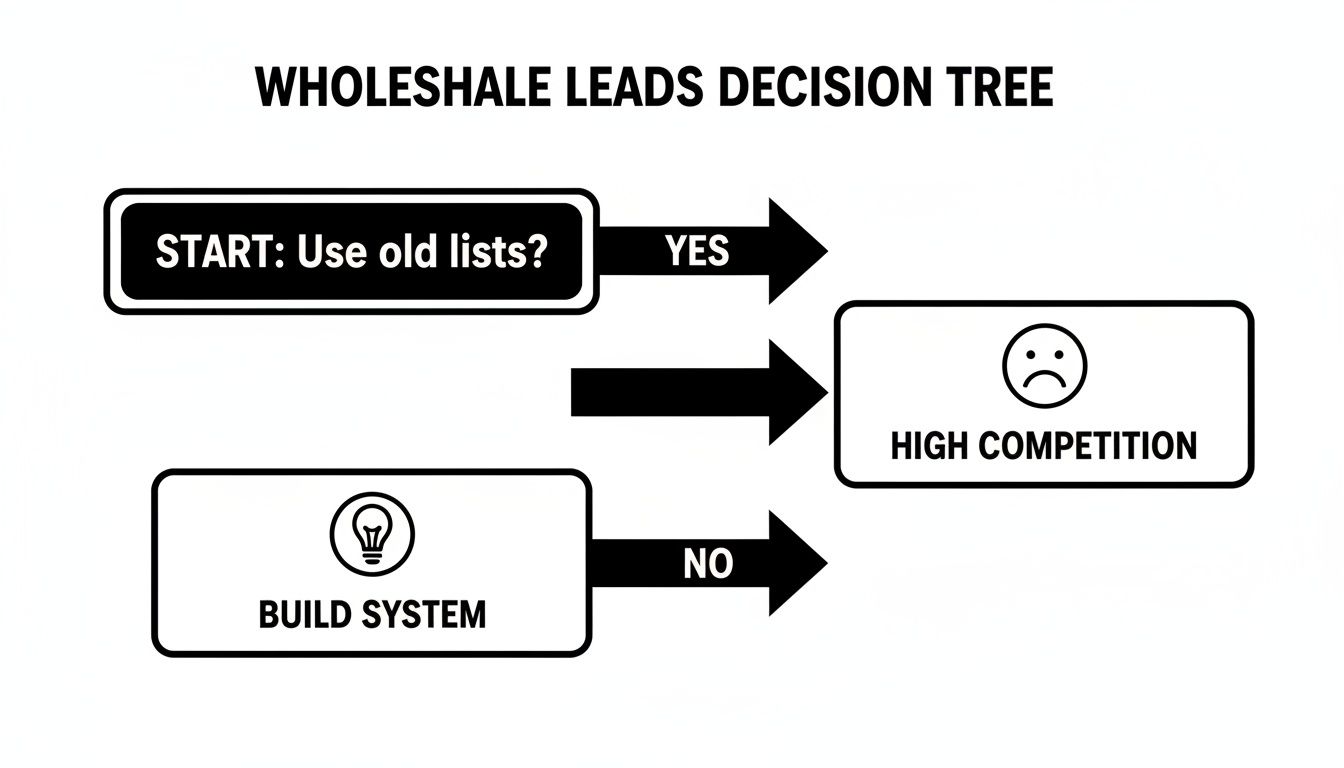
The key takeaway is simple: relying on purchased lists puts you on the defensive, fighting tooth and nail against heavy competition. Building your own data-driven system gives you a proactive, first-mover advantage.
The Power of List Stacking and Lead Scoring
The real magic happens when you start combining these individual distress signals—a technique we call list stacking. A single signal is just a hint; multiple signals paint a detailed picture of true motivation. This is where you gain a massive competitive edge.
Let's walk through a real-world scenario. You pull a list of properties with code violations. On its own, that's a decent starting point. But then you cross-reference that list with your tax delinquency data. Suddenly, you find a homeowner who not only has an overgrown yard but also hasn't paid property taxes in two years. Now we're talking.
By layering data, you create a motivation score for each lead. A property with a single distress signal might get a score of 3, while one with three signals—like an out-of-state owner, a code violation, and high equity—could be a 9 or 10. This scoring system lets you pour your time, money, and energy into the leads most likely to convert.
This methodical process is the foundation of a predictable deal pipeline. For a deeper dive into how data can transform your lead generation, check out our guide on predictive analytics in real estate.
This data-first approach also lets you personalize your outreach for maximum impact. Instead of sending a generic "we buy houses" postcard, you can craft a message that speaks directly to the owner's situation. You show empathy and a genuine desire to help solve their specific problem. That's how you build trust and become the first person they call.
Crafting Compliant and Effective Outreach Campaigns
Okay, you've got your prioritized list of high-probability sellers. Now for the hard part: actually making contact. This is precisely where so many wholesalers drop the ball. Come in too hot or too generic, and you're getting ignored. But get sloppy with compliance, and you could be facing some serious legal heat.
The sweet spot is a multi-channel strategy that’s both empathetic and legally airtight. It's all about building genuine rapport with people who are, more often than not, going through a tough time.

We need to move past the tired, spammy "we buy houses" noise that clogs up mailboxes and voicemails. The goal is to build a smart contact sequence that builds from low-touch to high-touch, meeting sellers on their terms, with a message that actually connects.
The Human-Centric Outreach Model
The campaigns that kill it in this business are built on empathy, not just sheer volume. Let's be real: you're often calling people at a low point. A human-centric approach doesn't ignore that—it leans into it. You're a problem-solver first, an investor second.
This model is all about personalization and making a real connection. Your first message shouldn't read like a bulk mailer. It needs to feel like a personal note from someone who gets what they're going through and just might have a solution.
Your outreach isn't about you or your need to find a deal; it's about the seller's problem. Frame every single message around their situation and how you can offer a simple, stress-free way out. This subtle shift in perspective is what separates the top-tier wholesalers from everyone else.
Building a Multi-Channel Contact Sequence
Putting all your eggs in one basket—whether it's only direct mail or only cold calling—is a rookie mistake. Some people open every piece of mail, others live on their phone, and a few will only respond to a text. A layered, multi-channel approach is how you meet sellers where they're most comfortable.
Here’s a sample flow I've seen work incredibly well, designed to gently ramp up contact:
- Initial Direct Mail: Kick things off with a high-quality, personalized letter or postcard. It’s a non-intrusive way to get on their radar. A handwritten font or a unique postcard design can make all the difference between being seen and being trashed.
- Follow-Up SMS: A few days after your mailer should have landed, send a soft-touch text. The key is to reference the letter they just received. This makes the outreach feel cohesive, not random.
- Empathetic Cold Call: If you haven't heard back, a polite and respectful phone call is your next move. The objective isn't to corner them into a 'yes' or 'no.' It's simply to open a conversation and see if they're even open to talking.
- Final Email: As a final, low-pressure touchpoint, a simple email can recap your offer to help. It gives them another easy way to get in touch if and when the time is right for them.
This sequence increases your odds of making a connection without being annoying. The name of the game is persistent but respectful follow-up.
Navigating the Essentials of Compliance
All this great outreach is worthless if it's not compliant. The Telephone Consumer Protection Act (TCPA) has incredibly strict rules for SMS and cold calling, and you absolutely must follow them to avoid crippling fines.
The regulations can get dense, but here are the absolute non-negotiables:
- Scrub Your Lists: Always, always, always run your contact lists against the National Do Not Call Registry before you dial or text anyone. No exceptions.
- Obtain Consent: For any kind of automated SMS marketing, you need express written consent. Manual, one-to-one texting is a much safer harbor, but you still have to be careful.
- Provide an Opt-Out: Every single text must give the recipient a clear, easy way to opt out, like "Reply STOP to unsubscribe."
- Identify Yourself: Don't be mysterious. Your first message has to clearly state who you are and what company you're with.
Violating TCPA can lead to fines from $500 to $1,500 per incident. If you're sending hundreds of texts, you can do the math—it's a business-ending risk. Investing in a compliant dialing and SMS platform isn't an expense; it's insurance.
At the end of the day, while digital outreach offers scale, nothing builds trust faster than a face-to-face conversation. In fact, wholesalers who make it a priority to get in-person visits scheduled within 24 hours of generating a lead can see 5x higher conversion rates than those who just stick to the phone. You can find more marketing insights about the power of direct engagement and how it truly closes deals.
Leveraging AI and Automation to Scale Appointments
Manual lead qualification is the single biggest bottleneck that kills a wholesaler's momentum. We've all been there: you spend a ton of time and money generating real estate wholesale leads, only to watch them go cold because you couldn't follow up fast enough. This is the moment you shift from being just a deal-finder to a true business operator, building a system that works for you 24/7.
Bringing in AI and automation isn't about replacing the human touch; it's about scaling it. The whole idea is to offload the repetitive, time-sensitive stuff so your acquisitions team can focus on what they do best—having quality conversations with genuinely motivated sellers.

Deploying Your AI-Powered Inside Sales Agent
Picture this: every single inbound lead—whether from a text reply, a website form, or a direct mail callback—gets engaged within seconds. Not minutes. Not hours. Seconds. That's the power of an AI-powered Inside Sales Agent (ISA).
Think of an AI ISA as an incredibly smart chatbot trained specifically for real estate wholesaling. It can jump on initial conversations across SMS and email, asking the crucial qualifying questions you'd ask yourself.
It's programmed to understand a seller's intent, get a feel for their motivation, and gather the essential property details. Once the AI decides a lead is qualified and ready for a real conversation, it seamlessly books an appointment right on your acquisitions manager's calendar. No more tedious back-and-forth trying to find a time that works.
The real magic here is speed to lead. The first person to have a meaningful conversation with a motivated seller usually gets the deal. An AI ISA makes sure you are always first in line, engaging leads when their interest is at its peak, even if it's 2 AM on a Sunday.
Building Automated CRM Workflows
Your CRM should be the central nervous system of your business. But without automation, it’s just a glorified address book. The trick is to build smart workflows that fire off automatically based on lead behavior. This saves hundreds of hours and stops good opportunities from falling through the cracks.
Here are a few must-have workflows you can set up:
- New Lead Ingestion & Follow-Up: A new distressed lead gets added, and the system instantly kicks off a multi-channel outreach sequence. Maybe it starts with a direct mail piece, followed by an SMS from your AI ISA a few days later, and then an email.
- Status-Based Task Creation: If a lead's status changes to "Appointment Set," a task is automatically created for your acquisitions manager to prep for the call. If it changes to "Follow-Up Needed," the lead gets dropped into a long-term nurture sequence.
- Appointment Reminders: The system automatically sends text and email reminders to the seller 24 hours and 1 hour before a scheduled appointment, which drastically cuts down on no-shows.
By weaving these kinds of AI-driven workflows into your process, you can automate up to 80% of your back-office tasks, from sending reminders to updating your CRM. For a lot of successful PropTech firms and brokerages, this is the exact playbook that lets them scale to 15-20 qualified appointments every single month.
A Real-World Automation Scenario
Let's walk through how this all fits together. A new probate lead gets scraped from county records. Here’s how your automated system handles it from start to finish, with zero human input:
- The lead's data is automatically skip-traced and enriched with phone numbers and email addresses.
- The system adds the property to your direct mail campaign, firing off a personalized letter.
- Five days later, the AI ISA sends a text message, casually referencing the letter they received.
- The heir texts back, showing some interest. The AI starts a natural conversation, asking about the property's condition and their selling timeline.
- Once qualified, the AI offers up available slots on your calendar and books the appointment on the spot.
- The appointment, along with the full conversation history, gets pushed directly into your CRM.
This entire dance happens on autopilot, letting your team walk in to a calendar full of pre-vetted appointments. If you want to really dial this in, exploring the best data enrichment tools can seriously boost your data quality and targeting accuracy from the very first step.
For a deeper dive, check out our detailed guide on how to use AI for real estate agents. This level of systemization is what separates the amateur wholesalers from the professional operators building a scalable, predictable business.
Measuring and Optimizing Your Lead Funnel for Profitability
Getting a steady flow of real estate wholesale leads is a huge milestone, but honestly, that’s only half the battle. If you want to build a business that's truly scalable and predictable, you have to shift your mindset. Stop focusing just on doing deals and start systematically improving your entire process. A sophisticated lead engine runs on clear Key Performance Indicators (KPIs) to show you what’s working, what's a dud, and where to put your money for the best bang for your buck.
It's a simple truth: you can't optimize what you don't measure. Flying blind means you could be torching cash on marketing channels that never convert or wasting precious time on leads that were never going to close anyway. This is the critical step that separates amateur wholesalers from the professional operators who build lasting, profitable machines.
Establishing Your Core Funnel Metrics
To get a real pulse on your business's health, you need a central dashboard. It doesn't have to be fancy—even a simple spreadsheet works wonders—but it must track a few non-negotiable metrics. These numbers tell the story of your funnel, from the very first postcard you send all the way to a closed deal and a check in your hand. Watching them weekly is the key to spotting trends and uncovering opportunities.
Your essential KPI dashboard should include:
- Cost Per Lead (CPL): This is your total marketing spend on a campaign divided by the leads it brought in. If you spend $1,000 on direct mail and get 50 calls, your CPL is $20. Simple.
- Cost Per Appointment (CPA): This takes it a step further. If those 50 leads turn into 5 qualified appointments with motivated sellers, your CPA is $200 ($1,000 / 5 appointments). Now we're getting warmer.
- Appointment-to-Contract Ratio: This one measures how effective your acquisitions team is when they're face-to-face (or on the phone) with a seller. If you sign 1 contract for every 5 appointments, you've got a 20% ratio.
- Return on Investment (ROI): This is the granddaddy of them all. If that $1,000 you spent on the mail campaign led to a single contract with a $10,000 assignment fee, your ROI is a beautiful 10x.
Tracking these numbers religiously is what moves you from guesswork to data-driven decisions. You’ll know with certainty which lead sources are printing money and where you need to double down.
Fine-Tuning Your Outreach with A/B Testing
Once you have your baseline metrics locked in, the real fun begins. It's time to start optimizing. A/B testing, or split testing, is a ridiculously powerful way to make small, incremental improvements that compound into massive wins over time. The idea is simple: you pit one version of something against another to see which one performs better.
This is how you scientifically improve your marketing instead of just going with your gut.
The golden rule of A/B testing is to only change one single variable at a time. If you change the headline, the call-to-action, and the postcard design all at once, you'll have no earthly idea which change actually moved the needle. Be methodical. Be patient.
Here are a few practical A/B tests you can run right away:
- Direct Mail: Test a clean, professional postcard against a more personal, handwritten-style letter. You might be surprised by the results.
- SMS Scripts: Try a super-direct opener ("Are you the owner of 123 Main St?") against a softer, more conversational approach ("Hi, I'm trying to reach the owner of the property on Main St. Can you help?").
- Email Subject Lines: Pit a straightforward subject line like "An offer for your property" against something that sparks curiosity, like "A quick question about your house."
Let each test run until you have a decent sample size—usually at least 100-200 sends for each version to get reliable data. Over time, these little wins will dramatically lower your cost per lead and crank up your overall profitability, turning your lead funnel into a well-oiled machine.
A Few Common Questions About Wholesale Leads
As you start to build a real wholesale business—not just a side hustle—a lot of questions pop up. Moving from chasing random deals to building a predictable, automated machine is a big shift. Here are some of the most common questions I get, along with some straight-up, practical answers.
What Are the Best Kinds of Distressed Property Leads?
Look, everyone and their brother is pulling pre-foreclosure and tax lien lists. They’re a starting point, sure, but they’re also incredibly crowded. The competition is fierce because the barrier to entry is zero.
The real money is made by finding leads that nobody else sees. This isn't about finding one magic list; it's about layering different kinds of distress signals together to paint a complete picture.
Think about it: a property with an out-of-state owner is interesting. That same property with a recent code violation and a mountain of equity? Now you've got a high-probability lead that your competition probably missed. Probate leads are another goldmine. Heirs, especially ones who live hours away, are almost always motivated to cash out an inherited property fast. They don't want the headache of maintenance, taxes, and repairs.
The secret is to have a system that's pulling data from multiple county-level sources at the same time. This lets you build a unique profile of distress and find opportunities that are completely invisible if you're only looking at one data point.
How Do I Make Sure My SMS and Cold Calling Are Compliant?
This is the one area where you absolutely cannot afford to mess around. Compliance isn’t just a good idea; it’s non-negotiable. Getting this wrong can lead to fines that will put you out of business, period. You have to take the Telephone Consumer Protection Act (TCPA) seriously.
Here’s the bare minimum you need to be doing for any phone or text outreach:
- Scrub Your Lists: Before you dial or text a single number, you must scrub your list against the National Do Not Call Registry. No exceptions.
- Ditch the Autodialers: Don’t even think about using an autodialer or any kind of automated texting system unless you have explicit written consent. Stick to manual, one-to-one communication to stay safe.
- Make Opt-Outs Obvious: Every single text needs a clear and simple way for someone to say "no more." Something like "Reply STOP to end messages" is standard.
- Say Who You Are: Be upfront from the very first contact. Your name, your company’s name—it should all be in that first message.
Seriously, work with a tech platform that has compliance built into its DNA. And spending a little money to talk with a lawyer who actually understands TCPA is one of the smartest investments you can make.
Is It Better to Buy Wholesale Lists or Build My Own?
Buying lists from the big national data companies is how a lot of wholesalers get their start. It's easy. But it's also a trap that keeps you small. Those lists are often old, inaccurate, and—worst of all—sold to hundreds of other investors in your exact market. You end up in a race to the bottom, competing on price with dozens of others who are calling the exact same tired leads.
The only sustainable, long-term competitive advantage is to build your own proprietary list by pulling fresh data directly from local county records. When you do this, your real estate wholesale leads are truly exclusive. You’re not the tenth person to call a motivated seller; you're the first.
Yes, it takes more work to set up. You either have to build the tech yourself or partner with a service that does the heavy lifting for you. But the payoff is massive. Owning your data source means you get higher-quality leads, your conversion rates skyrocket, and your business becomes far more profitable and predictable. It’s the difference between running a temporary hustle and building a real, scalable asset.
At Tab Tab Labs, we build automated distressed lead engines that fill your calendar with exclusive, pre-qualified seller appointments. Stop fighting over stale lists and start owning your market. Schedule a free strategy call today and let us show you how to build a predictable pipeline.