How to Buy a Pre Foreclosure House: A Savvy Investor's Guide
Learn how to buy a pre foreclosure house with this practical guide. Discover insider tips for finding properties, negotiating deals, and securing financing.
By James Le
Buying a pre-foreclosure house is all about timing and problem-solving. You’re stepping in to purchase a property directly from a homeowner who’s behind on their mortgage, but before the bank officially takes it back at auction.
The whole strategy hinges on finding these distressed homeowners, striking a deal that makes both them and their lender whole, and having the financing ready to close fast. It's a fantastic way to find properties below market value by offering a lifeline to someone in a tough financial spot.
Understanding the Pre-Foreclosure Opportunity
Think of pre-foreclosure as a critical window. It opens the moment a lender files a public notice of default against a homeowner and slams shut the second the property is sold at auction. This period can be a few short months or drag on for more than a year, and during that entire time, the homeowner still legally owns the property and has every right to sell it.
This is where you come in.
The homeowner is usually incredibly motivated. They're looking for a way to avoid the credit score nightmare that a formal foreclosure brings. For them, selling to you isn't just a transaction; it's often the best possible way out of a bad situation, letting them pay off the bank and maybe even pocket a little equity.
The Appeal for Buyers and Investors
For an investor, the upsides are pretty clear. You're not dealing with a faceless bank or an asset manager; you're working directly with a person in a tight spot. This creates some serious advantages:
- Below-Market Prices: Most sellers in this position aren't trying to squeeze every last penny of profit out of the deal. Their main goal is to cover the loan balance, which leaves a lot of room for you to negotiate a great price.
- Less Competition: These deals are almost always off-market. You're not getting into a bidding war with dozens of other buyers like you would at an auction or with a publicly listed home.
- Property Access: Unlike at a foreclosure auction where you're buying sight-unseen, you can almost always walk through and inspect a pre-foreclosure property before you make an offer. That alone is a massive risk-reducer.
The current market is ripe for this kind of investing. Foreclosure starts jumped 7% in the first half of 2025, which translates to over 140,000 U.S. properties entering the pipeline. That's a growing inventory of potential deals for anyone sharp enough to find them. Timelines are everything, so it’s crucial to understand things like how long the foreclosure process takes in Pittsburgh PA, as it varies wildly from state to state.
The Pre-Foreclosure Process at a Glance
Before jumping in, it's vital to get a clear picture of the entire pre-foreclosure landscape. The table below breaks down the essential components, helping you understand the roles, timeline, and key terms involved.
| Component | Description | Key Takeaway for Buyers |
|---|---|---|
| Notice of Default (NOD) | The first public, legal notice filed by the lender when a homeowner misses payments. This officially kicks off the pre-foreclosure period. | This is your starting gun. The NOD is public record, making it a primary source for finding potential leads. |
| Loan in Default | The outstanding mortgage balance, plus any missed payments, late fees, and legal costs the lender has incurred. | This is the magic number. Your offer must be high enough to cover this entire amount to satisfy the lender. |
| Homeowner's Equity | The difference between the property's market value and the total loan amount in default. It can be positive or negative (underwater). | Positive equity is your negotiation sweet spot. It means the homeowner can pay off the loan and still walk away with cash. |
| Short Sale | A sale where the lender agrees to accept less than the total amount owed on the loan. Required when the property is underwater. | This adds a layer of complexity. You'll need the lender's approval for the sale, which can be a slow and uncertain process. |
| Auction Date | The scheduled date when the property will be sold to the highest bidder if the homeowner can't resolve the debt. | This is your deadline. You must close the deal before this date, or the opportunity vanishes. |
Getting a handle on these elements is the first step. You're not just buying a house; you're navigating a complex financial situation with a hard deadline.
Key Players in the Process
You need to know who you're dealing with before you even make the first call. This isn't a straightforward transaction between a buyer and a seller. The big difference is the lender's oversized role in the whole process.
Even though you're negotiating directly with the homeowner, any deal you make is meaningless unless it's enough to pay off their debt to the bank. While the benefits of this niche are huge, it's not without its challenges. For a balanced view, check out our guide covering the pros and cons of buying a foreclosed home.
Finding and Qualifying Pre Foreclosure Properties
Sourcing pre-foreclosure deals isn't about getting lucky; it's about building a systematic pipeline. If you're waiting for these properties to pop up on the MLS, you're already too late. The best investors create their own flow of leads by tapping into a mix of public and private data sources. This is how you find opportunities long before the rest of the market even knows they exist.
The old-school, foundational method is still one of the best: go straight to the public records. County courthouses are treasure troves of information, specifically the Notice of Default (NOD) or Lis Pendens filings. These documents are the official starting pistol for the foreclosure process, filed by lenders to make a homeowner's delinquency a matter of public record.
This isn't just a quick Google search. It often means getting your hands dirty, either by physically visiting the county clerk's office or navigating their sometimes-clunky online portals. It's more work, sure, but the data is raw, unfiltered, and immediate. That gives you a serious head start.
Mastering Online and Professional Networks
Beyond trekking to the courthouse, several online platforms can give your search a massive boost. They might not be as bleeding-edge current as direct records, but they make up for it in sheer efficiency.
- Specialized Listing Services: Think of platforms like RealtyTrac or Foreclosure.com as your data aggregators. They are subscription-based, but they save you an incredible amount of time by pulling nationwide pre-foreclosure data into a single, searchable database.
- Mainstream Real Estate Sites: Even big players like Zillow now have a pre-foreclosure filter. The data can lag a bit and isn't always perfectly accurate, but it’s a fantastic—and free—way to spot potential deals and cross-reference leads you've found elsewhere.
This simple diagram shows how the process unfolds and where you, as an investor, can step in to create a win-win situation.
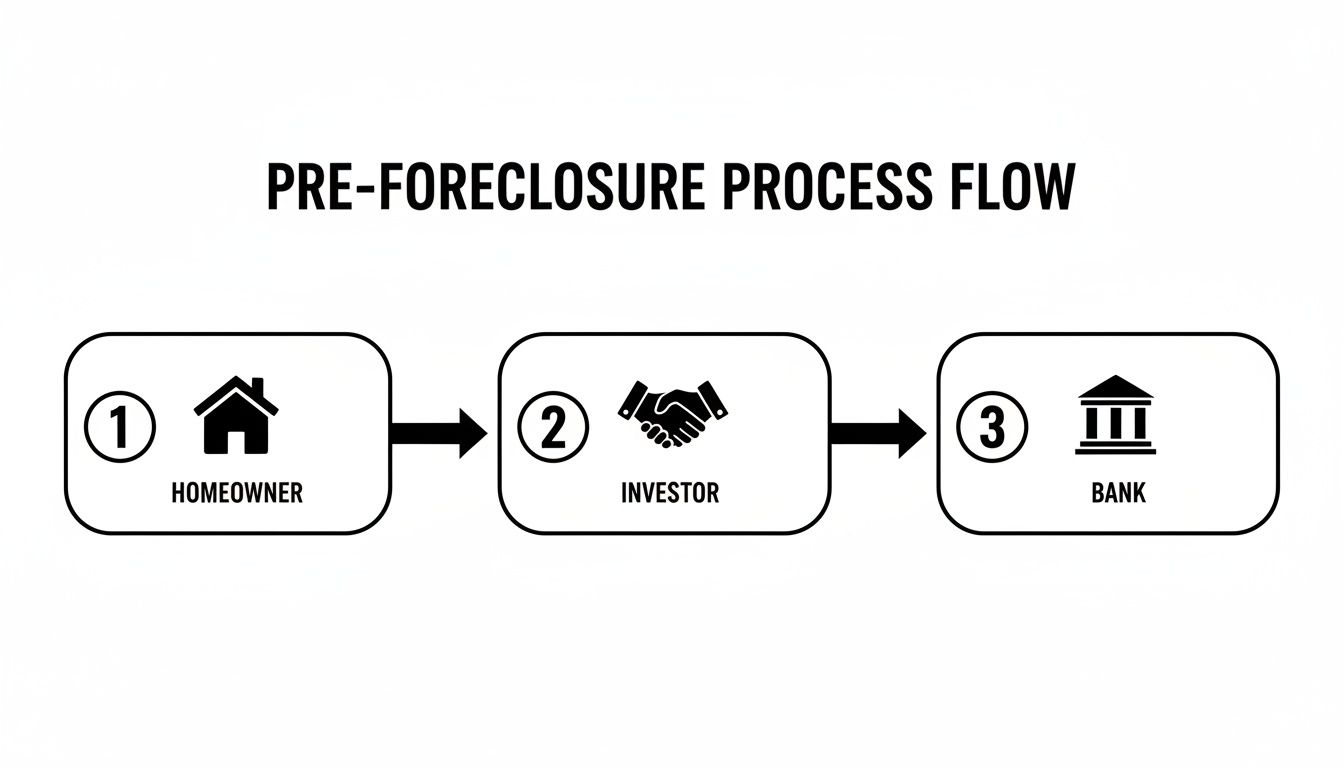
As you can see, your involvement provides a crucial off-ramp for the homeowner, giving them an alternative to a full-blown foreclosure and auction by the bank.
Never underestimate the power of your local network. Real estate attorneys, especially those who handle bankruptcy or probate, are often the first to know when a homeowner is in distress. Wholesalers are another great source; they're constantly digging for deals and might pass along a lead that doesn’t quite fit their own criteria.
Qualifying Leads for Maximum Potential
Finding a lead is just step one. The real work—and where the money is made—is in qualifying it. Not every pre-foreclosure is a diamond in the rough. You need to quickly filter out the duds and focus on properties that hit three key benchmarks: enough equity, a motivated seller, and a decent location.
A property with a healthy amount of equity is your prime target. It means there's enough value baked in to pay off the mortgage, clear any other liens, and still leave some cash for the homeowner and a profit for you. A quick CMA is your best friend here.
The current market makes this a particularly powerful strategy. Filings in August were up 18% year-over-year for the sixth month in a row and are on pace to fly past 2024's total of 322,000. To get a statistical edge, zero in on states with higher foreclosure rates like South Carolina (1 in every 1,982 units) or Illinois (1 in 2,570), where you'll find more frequent opportunities.
The key is to build a workflow. As leads come in, run a preliminary analysis. What's the estimated market value versus the loan balance? Is the neighborhood on the upswing? Check recent comps. This initial screen lets you toss the non-starters fast and pour your energy into the deals that actually have a shot.
For a much deeper dive into building out your lead generation machine, check out our detailed guide on how to find pre-foreclosure homes.
Performing Your Due Diligence
Finding a promising pre-foreclosure property is a rush, no doubt. But that’s just the starting line. What comes next—the due diligence phase—is where you separate the home runs from the financial train wrecks.
I can't stress this enough: skipping this step is the single biggest mistake you can make. It’s how a "bargain" quickly turns into a money pit. This isn't just a suggestion; it's your non-negotiable checklist for making sure a deal is solid from every angle.
The entire transaction lives or dies on one thing: a clear title. A property's title is its official ownership record, but it can get cluttered with claims from other parties. These claims are called liens, and they’re legal rights held by creditors until a debt gets paid.

Uncovering Hidden Liens with a Title Search
When you learn how to buy a pre-foreclosure house, you quickly find out the primary mortgage is rarely the only debt hanging around. Homeowners in financial distress often have multiple liens clouding up the title, and a comprehensive title search is the only way to drag them into the light.
A professional title company or a real estate attorney will dig through public records to find every single claim against the property. Your offer has to be big enough to satisfy not just the main mortgage but every other lienholder in line.
You'll run into all sorts of things. Common liens include:
- Second Mortgages or HELOCs: Home equity lines of credit are everywhere. They absolutely must be paid off.
- Tax Liens: Unpaid property, state, or even federal taxes can lead to liens from government agencies.
- Mechanic's Liens: A contractor who did work on the house but never got paid can file one of these.
- Judgment Liens: If a creditor won a lawsuit against the homeowner, they can place a lien on their property to collect.
Miss one of these, and you’re in for a world of hurt. Imagine closing on a house only to discover a $30,000 IRS tax lien you didn't know about. Guess what? That debt is now your problem.
Conducting a Thorough Property Inspection
Pre-foreclosure properties are almost always sold "as-is." That’s code for "what you see is what you get, and the seller isn't fixing a thing." This makes a meticulous property inspection absolutely critical. Distressed homeowners have usually deferred maintenance for a long time, so you need to look for problems that go way beyond a fresh coat of paint.
Bring a contractor you trust with you on the walkthrough. You need an expert’s eye to spot the expensive disasters an untrained person would miss—things like foundation cracks, ancient electrical systems, or the subtle signs of a roof that’s about to give up.
Get detailed, written estimates for every single repair. Vague "ballpark" figures are worthless here. You need hard numbers to calculate your total investment and figure out if the deal still makes any financial sense after rehab costs.
Calculating Your Maximum Allowable Offer
Once you have the full story on the property's condition and title, it’s time to calculate your maximum allowable offer (MAO). This simple formula is your best friend—it protects your profit margin and stops you from getting emotional and overpaying.
The goal isn't just to get a "good deal" compared to market value. It's to lock in a price that guarantees a profitable outcome for your specific exit strategy, whether you're flipping or renting.
Here’s the basic formula every savvy investor lives by:
MAO = After Repair Value (ARV) - Repair Costs - Closing Costs - Desired Profit
Let's walk through a real-world scenario.
- After Repair Value (ARV): You've run the comps on similar, fully renovated homes in the neighborhood. You determine the property will be worth $350,000 once you’re done with it.
- Repair Costs: Your contractor gave you a detailed estimate totaling $45,000.
- Closing & Holding Costs: You budget $15,000 to cover title fees, insurance, utilities while you work, and other transaction costs.
- Desired Profit: You're not doing this for charity. You want to make a minimum profit of $40,000.
Now, just plug it into the formula: $350,000 (ARV) - $45,000 (Repairs) - $15,000 (Costs) - $40,000 (Profit) = $250,000 (MAO)
That’s it. $250,000 is the absolute highest you can go. If the total of the outstanding mortgage and all the other liens adds up to more than that, you have to be disciplined enough to walk away. Sticking to your MAO is the ultimate form of due diligence. It ensures every pre-foreclosure you buy is a calculated, profitable move.
Negotiating With The Homeowner
After you've run the numbers and confirmed a property has potential, you're stepping into the most delicate phase of this whole process: the human element. This isn't just about spreadsheets and ARV anymore. You're approaching someone who is likely going through a major personal and financial crisis.
Your ability to blend genuine empathy with a clear, strategic offer is what separates the successful investors from everyone else. You need to pivot from being an analyst to being a problem-solver. The homeowner is buried under an avalanche of pressure—creditors calling, the auction date looming. Your entire approach has to position you as a credible, helpful alternative. You're there to offer a way out, not to profit from their misfortune.

Crafting Your Initial Outreach
How you make that first contact sets the tone for everything that follows. A cold, aggressive pitch will get the door slammed in your face, literally or figuratively. Your only goal at this stage is to build rapport and establish a baseline of trust.
Whether you decide to send a letter, make a call, or find a warm introduction, the core of your message needs to be consistent and respectful.
- Acknowledge their situation with tact. Avoid language that sounds accusatory or predatory. Simple phrases like, "I understand this might be a difficult time," can show you're coming from a place of compassion.
- Position yourself as a solution. You need to frame your interest as a way for them to avoid the credit-destroying impact of foreclosure, maybe even walk away with some cash, and finally move on.
- Be direct, but never pushy. Clearly state your interest in buying their property and emphasize that you can offer a fast, straightforward closing.
I've seen many investors find a lot of success with a soft-touch letter campaign before they even think about picking up the phone. It gives the homeowner a minute to process the idea on their own terms, without feeling cornered.
Structuring A Win-Win Offer
Your offer absolutely has to be anchored to that Maximum Allowable Offer (MAO) you calculated earlier. But how you present that number is just as critical as the number itself. Don't just throw a price at them; walk them through the logic.
Break it down so they can see exactly how your offer covers the outstanding mortgage, settles any liens, and accounts for your estimated repair costs. When they can follow the math, it feels less like a lowball number and more like a realistic solution based on the property's true condition.
Mentioning how your purchase can help them find motivated seller leads for their next home can be a powerful way to show you're thinking about their future, too.
Key takeaway: The best negotiation is collaborative. Your objective is to present an offer that solves the homeowner's single biggest problem—the looming foreclosure—while still protecting your own bottom line.
There are several ways to approach the conversation, each with its own pros and cons.
Effective Negotiation Strategies for Pre-Foreclosure Deals
| Strategy | Best For | Key Consideration |
|---|---|---|
| Empathy-First Approach | Building initial trust with distressed homeowners who are emotionally overwhelmed. | Requires genuine listening skills. Your primary goal is to understand their needs before presenting a solution. |
| Problem-Solver Framing | Homeowners focused on the practical outcomes, like avoiding credit damage or getting cash to move. | Clearly articulate how your offer solves their specific problems (e.g., "This offer stops the auction and puts $X in your pocket.") |
| Open-Book Transparency | Analytical homeowners who want to see the numbers. Good for building credibility. | Be prepared to share your MAO calculation, including repair estimates and holding costs. This builds trust but reduces negotiation room. |
| "As-Is" Cash Offer | Situations where speed and certainty are the most attractive selling points for the homeowner. | Emphasize the convenience: no repairs, no showings, no commissions, and a guaranteed closing date. |
Choosing the right strategy depends entirely on reading the person and the situation. Sometimes, you might even blend a couple of these approaches.
Decoding The Short Sale Process
Now and then, you'll find a property where the total debt owed is more than the house is worth, even after you fix it up. When a homeowner is "underwater" like this, the only viable path forward is often a short sale.
This is a more complicated deal. You're not just negotiating with the homeowner; you're negotiating directly with their lender, asking them to accept less than the full mortgage balance.
Why would a bank agree to this? Because a short sale is usually faster and cheaper for them than going through a full foreclosure, auction, and then trying to sell a vacant property. This is especially common in states with high foreclosure rates. For instance, states like Delaware (1 in every 2,325 housing units with a filing) and Nevada (1 in 2,417) present these opportunities frequently. To get started, you'll submit a full short sale package to the lender, which includes your offer, proof of funds, and comps to justify the lower price. You can explore the latest state-by-state foreclosure trends to see where these are most common.
Be warned: navigating a short sale requires a ton of patience. Lender approval can drag on for months, and there's never a guarantee they'll say yes. But if you can stick it out, short sales can lead to some of the most profitable deals in real estate, allowing you to acquire properties at a serious discount.
Financing and Closing Your Purchase
Let's get one thing straight: securing the money for a pre-foreclosure is a completely different ballgame than getting a standard mortgage. The usual timelines just don't work, and the property conditions can be a huge hurdle. You have to start thinking like a creative problem-solver, not a typical homebuyer. In this arena, speed and certainty are your most valuable assets.
Sure, it's technically possible to buy a pre-foreclosure with a conventional loan, but I almost never recommend it. Lenders for those loans have incredibly strict appraisal and inspection requirements. If the property has a leaky roof or a busted furnace—which is pretty common in these situations—it simply won't qualify. The resulting delays will kill the deal.
The seller is staring down an auction date. A financing plan that takes 45-60 days to get approved is a non-starter. Your ability to close fast is a powerful negotiation tool, sometimes even more so than your offer price.
This is exactly why cash is king in the world of distressed properties. A cash offer cuts through all the lender bureaucracy, appraisal contingencies, and painful underwriting periods. It sends a clear signal to the seller: you're serious, and you can close before the bank takes the house.
Exploring Agile Funding Solutions
When you can't bring a briefcase full of cash to the table, you need funding that matches the urgency of the deal. This is where alternative lenders become your best friend, especially if you plan on buying pre-foreclosures consistently.
- Hard Money Loans: Think of these as short-term, asset-based loans from private companies. Hard money lenders care more about the property's After Repair Value (ARV) than your personal credit score. The big win? They can often fund a deal in just 7-14 days, giving you the speed to compete with all-cash buyers.
- Private Money Loans: This is all about your network—borrowing from friends, family, or other investors. The terms are completely negotiable, which offers incredible flexibility. If you've got a good track record and a solid deal, this can be an amazing way to get the funds you need quickly.
Before you even think about making an offer, get your financing locked down. This means having a proof of funds (POF) letter ready to send. A POF is just a document from a bank or lender stating you have the liquid capital to close. Submitting an offer without one is the fastest way to get your offer thrown in the trash.
Navigating The Closing Process
Once you have a signed purchase agreement and your money is lined up, it's time to bring it home. The closing process is where all the legal and financial threads get tied together to officially transfer ownership. Given the messes that can come with pre-foreclosures, you need a team of pros who specialize in distressed deals.
Your go-to team will include a real estate attorney and a title company. Their roles are distinct but work in tandem:
- The title company is your safety net. They're responsible for making sure the property's title is free and clear of any surprise claims or liens. They do the final title search and issue title insurance to protect you down the road.
- The real estate attorney is your advocate. They review every contract, prepare closing documents, and ensure the entire transaction follows state laws. Their job is to protect your interests every step of the way.
The final step is the closing itself. This is where you sign all the important paperwork, like the deed (which officially puts the property in your name) and the settlement statement (usually a HUD-1), which breaks down every single cost. At this point, your funds are transferred, the seller's mortgage and other liens are paid off from the proceeds, and you get the keys. Your hard work has finally paid off—you've got a clean title to your new investment property.
Common Mistakes to Avoid
Working in the pre-foreclosure space is a high-stakes game, and believe me, learning from the mistakes of others can save you a world of hurt and thousands of dollars. Even investors who have been around the block a few times can make critical errors that turn a hot deal into a money pit. If you're serious about figuring out how to buy a pre-foreclosure house, you need to know where the landmines are buried.
Underestimating The Rehab Budget
One of the most common—and most expensive—mistakes I see is wildly underestimating repair costs. You’re dealing with a property sold “as-is” by a homeowner who is, by definition, financially distressed. It's almost a guarantee there's a laundry list of deferred maintenance.
What might look like a quick cosmetic touch-up can easily mask a five-figure plumbing disaster or a fried electrical panel hiding behind the drywall.
The only way to protect yourself here is to get multiple, highly-detailed quotes from contractors. Make it a non-negotiable part of your due diligence. Never, ever rely on a ballpark guess or your own assessment unless you're a licensed pro. Those hard numbers are the only thing standing between you and a busted budget.
Failing to Plan Your Exit
Another classic mistake is jumping into a deal without a crystal-clear exit strategy mapped out before you even think about making an offer. Are you flipping it? Holding it as a rental? Moving in yourself? Each path dictates entirely different financing, renovation standards, and profit calculations.
If you don't have a defined goal, you can't possibly calculate your Maximum Allowable Offer (MAO) with any accuracy. This is how people end up overpaying or, just as bad, renovating to the wrong standard for their market. You can wipe out your entire profit margin before you even own the property.
Just as dangerous is skipping a thorough title search. The primary mortgage is often just the tip of the iceberg. I've seen deals torpedoed by hidden tax liens, mechanic's liens from an unpaid contractor, or second mortgages that suddenly pop up. These all attach to the property and become your problem after closing.
A professional title search isn't just an option; it's your primary form of risk mitigation. To truly safeguard your investment, you have to be vigilant about potential pitfalls. It's worth taking the time for some background reading on understanding common real estate scams that can surface during these kinds of complex transactions.
At the end of the day, success in this niche comes down to disciplined, process-driven decisions—not emotional ones.
Got Questions? We’ve Got Answers.
When you’re diving into the world of distressed properties, a lot of questions pop up. The process for buying a pre-foreclosure is a different beast than your standard real estate deal. Let’s tackle some of the most common things investors and agents ask.
Can You Really Buy a Pre-Foreclosure with Bad Credit?
While a low credit score definitely complicates things, it doesn’t automatically take you out of the game. A traditional mortgage is almost certainly a non-starter; lenders have strict requirements, and their approval process is way too slow for these kinds of time-sensitive deals.
But honestly, alternative financing is usually a much better fit here anyway.
Think about hard money lenders. They're less concerned with your personal credit history and more focused on the property's potential—specifically its After Repair Value (ARV). Other solid routes include partnering up with a cash-heavy investor or even securing a private loan from friends or family. The key isn't a perfect credit score; it's having access to financing that can close fast. That speed is your biggest bargaining chip with a distressed homeowner.
How Much of a Discount Can You Expect on Pre-Foreclosure Homes?
There's no magic number here. The discount you can get on a pre-foreclosure varies wildly depending on the situation. You have to factor in how much equity the homeowner has left, the actual condition of the property (and trust me, it can be rough), and what the local market is doing.
As a general rule of thumb, most investors are looking to buy these properties for 10% to 30% below whatever they're currently worth on the market. Your real success comes down to negotiating a price that doesn't just cover the mortgage and any liens, but also leaves you enough room to cover your renovation budget and hit your profit target.
The goal isn't just about getting a discount—it's about striking a deal that makes financial sense. A truly successful transaction is a win-win: the seller gets to walk away from foreclosure, and you pick up a valuable asset with built-in equity.
What Happens If the Homeowner Just Says No?
They can, and sometimes they will. No matter how great your offer is, a homeowner is never forced to sell their property to you. This is a risk you just have to accept when you're working in the pre-foreclosure space. They have other cards they can play.
For instance, they might be able to work out a loan modification with their bank. They could scrape together the money to catch up on payments and cure the default. They might even file for bankruptcy, which puts a temporary stop to the whole foreclosure process.
This is why you can't get emotionally attached to any one deal. The best operators always have a full pipeline of potential leads. Your entire business shouldn't hinge on a single homeowner saying "yes."
Ready to stop fighting over stale lists and start closing exclusive deals? Tab Tab Labs uses proprietary data and AI to deliver pre-qualified, motivated seller appointments directly to your calendar. Own your market and scale your operations with a predictable pipeline. Book your free strategy call today.