Finding Off Market Properties for Sale: The Ultimate Guide
Discover how to find, validate, and close deals on off market properties for sale. Learn the strategies real estate investors use to gain a competitive edge.
By James Le
An off-market property is simply a piece of real estate you buy directly from the owner, without it ever hitting public sites like the MLS. For a savvy investor, this is more than just a different way to buy—it's a strategy to completely sidestep the bidding wars, negotiate on your own terms, and often land a much better price than you'd ever find on the open market.
Why Off-Market Properties Are a Strategic Advantage
In a market where everyone is refreshing the same public listings, a small group of investors is quietly closing deals behind the scenes. These off-market deals aren’t some secret club; they’re the payoff for a deliberate, strategic approach to finding and buying property. It's about creating your own opportunities instead of waiting for them.
The most obvious win is the drastically reduced competition. When a property isn't plastered all over the internet, you're not fighting against a dozen other offers. This lets you have a real conversation with the seller, focusing on how to solve their problem instead of just throwing the highest number at them.
Beyond Less Competition
But the real power of off-market deals goes way beyond just avoiding a bidding war. It opens up a world of unique situations and motivated sellers you’d never find otherwise.
- Direct Negotiation: You're talking directly to the owner, not playing telephone through multiple agents. This direct line helps you understand what they really need—maybe it's a quick close, a way out of a tough financial spot, or just a discreet, hassle-free sale. You can then tailor your offer to be their perfect solution.
- Creative Deal Structuring: With less pressure, the door opens for creative financing. Think seller financing or subject-to deals—options that are almost impossible when you're in a competitive, on-market situation.
- Access to Hidden Inventory: Many owners, especially those facing some kind of distress, would rather sell privately. They want to avoid the stress and public exposure of a traditional sale. This creates a pipeline of exclusive deals that most of the market doesn't even know exists.
Capitalizing on Market Dynamics
This strategy is more powerful today than ever before. With global economic shifts putting pressure on homeowners, we're seeing more motivated sellers. For instance, as house prices fluctuate, more owners facing financial hardship—like tax liens or looming foreclosure—are looking to sell quietly to avoid losing even more value at a public auction.
A huge advantage lies in targeting these specific distress signals. For example, mastering the art of finding pre foreclosure properties puts you in front of sellers right when they need a solution most, long before their property hits the open market. These are people who often value a fast, guaranteed closing more than squeezing every last dollar out of the sale.
You can dive deeper into how to spot these opportunities in our guide on what is a distressed property.
The core advantage isn't just finding a cheaper house; it's about solving a seller's problem. When you can provide a fast, simple solution for someone in a complex situation, you create value that translates directly into a better deal for you.
Building Your Data Engine to Source Exclusive Leads
The secret to a killer off-market property strategy isn't luck; it's data. A powerful data engine, to be exact. If you want to consistently find off market properties for sale, you have to stop buying the same generic national lists everyone else has and start sourcing your own exclusive leads. It’s all about building a proprietary system that others simply can't replicate.
This whole process kicks off by going straight to the source: raw data from local county records. These public files are an absolute goldmine, full of breadcrumbs that point to a seller's motivation long before a property ever hits the market.
Tapping Into County-Level Data
Think of county records as the source code for property distress. While your competition is waiting for a "For Sale" sign to pop up, you can be digging into the underlying issues that force a sale in the first place. The real trick is knowing which records to pull and how to read the tea leaves.
I always start with these high-priority data sources:
- Tax Liens and Delinquencies: When a homeowner gets behind on property taxes, the county slaps a lien on their property. This is a massive sign of financial distress and a huge motivator for an owner to sell and walk away clean.
- Pre-Foreclosures (Lis Pendens): This is the public notice filed when a lender officially starts the foreclosure process. It’s a ticking clock, meaning the owner is likely desperate to sell and avoid having a foreclosure stain their record.
- Probate Filings: When a property owner passes away, the estate often has to go through probate court. The heirs might live out-of-state or just not want the headache of managing the property, making them incredibly motivated to sell fast.
- Code Violations: Properties with a laundry list of code violations—think overgrown yards, structural problems, or unpermitted construction—usually belong to owners who are either neglectful or completely overwhelmed. These are perfect candidates for an off-market offer.
By focusing on these local records, you're building a dataset that’s far more current and targeted than anything you’d get from national aggregators, which often have a serious data lag. For a much deeper dive, our guide on building high-quality real estate investor lists walks you through the nitty-gritty.
To give you a clearer picture, here’s how I think about the different data sources and what they really tell you.
Comparing Data Sources for Off Market Leads
This table breaks down some of the most common data sources. Notice how each one points to a different flavor of seller motivation and varies in how easy it is to access.
| Data Source | Motivation Signal | Data Accessibility | Lead Quality |
|---|---|---|---|
| Pre-Foreclosures | Time-sensitive financial distress. Owner needs to sell to avoid foreclosure. | Public record, but can be competitive. | High to Very High |
| Tax Delinquency | Clear financial hardship. Owner can't afford property taxes. | Public record, readily available at county offices. | High |
| Probate | Inherited property. Heirs are often distant and unattached to the asset. | Public record, requires monitoring court filings. | Very High |
| Code Violations | Neglect or inability to maintain the property. A sign of an overwhelmed owner. | Public record, but data can be inconsistent across municipalities. | Medium to High |
| Utility Shut-offs | Strong indicator of vacancy or abandonment. | Difficult to obtain directly; often sourced from third-party data providers. | High |
| Eviction Filings | Landlord is tired or losing money. Ready to exit the rental business. | Public record, accessible through county court records. | Medium to High |
Ultimately, the best leads come from layering these different data points together to find property owners facing multiple challenges.
Uncovering Alternative Distress Signals
County records are your foundation, but they're only part of the story. The truly exclusive, can't-miss leads come from combining that data with alternative signals of distress—the kind that are much harder for others to find. This is where you get a real first-mover advantage.
I’m talking about looking for signs of vacancy or neglect that will never show up in a government database. Things like utility shut-off notices or returned mail reports. These data points often scream "abandoned asset," where the owner would probably be thrilled to get an unsolicited offer.
The goal is to build a multi-layered profile of a property. A tax lien is one signal. But a tax lien plus a code violation and a utility shut-off notice? That’s a story of extreme motivation that tells you to act immediately.
This is exactly how you bypass the competition. Instead of fighting over the same tired MLS listings, you create your own pipeline of opportunities.
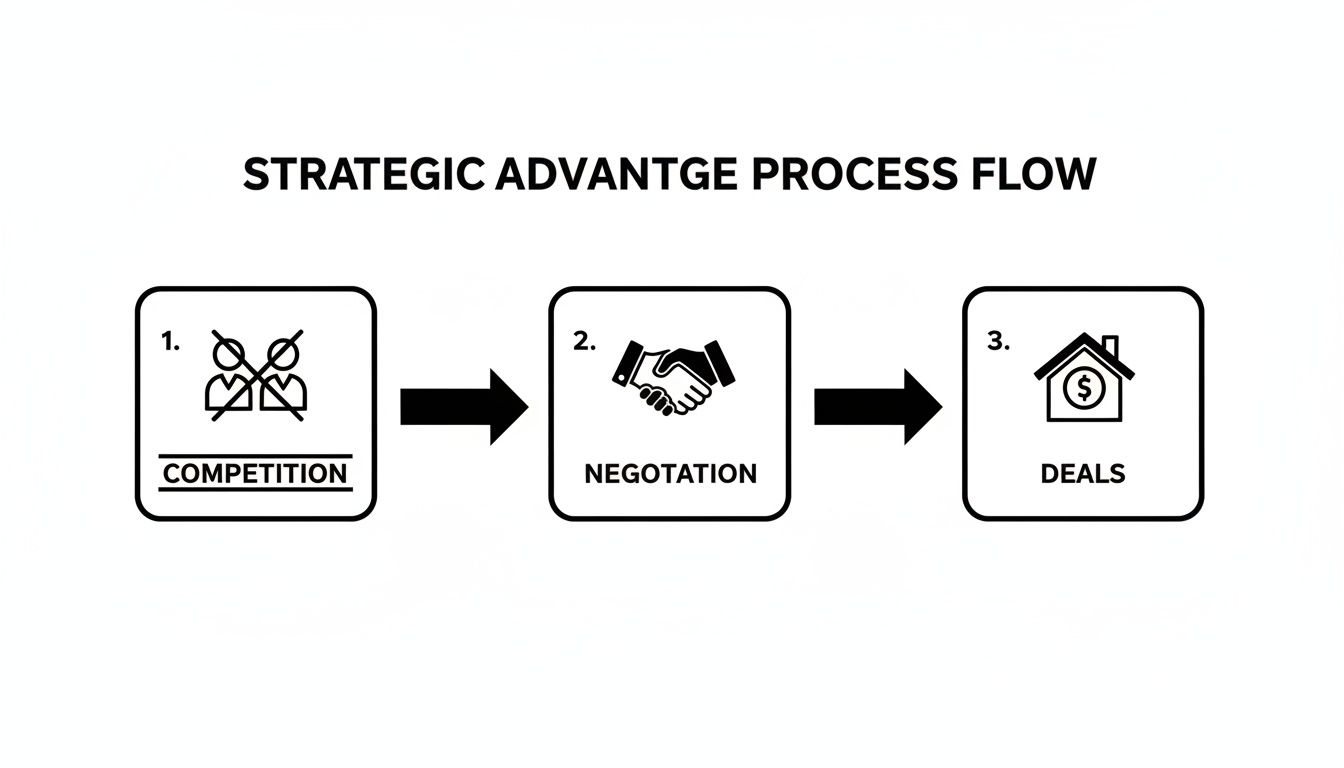
As you can see, when you source deals directly, you cut out the entire competitive bidding war, which puts you in a much stronger position to negotiate the terms you want.
Creating an Actionable Database
Just collecting all this raw data isn't enough. Its real power is unlocked only after you clean it, organize it, and enrich it inside a structured database or CRM. Trust me, raw county data is messy—full of formatting errors, duplicate entries, and missing info.
Your workflow needs to cover a few key stages:
- Standardization: First, make sure all your addresses, owner names, and property details follow a consistent, clean format. No exceptions.
- Data Cleansing: Next, you have to scrub the data. Get rid of all the duplicate entries and fix any obvious inaccuracies.
- Data Enrichment (Skip Tracing): Once you have a clean list of properties and owners, you need their contact info. This is where skip tracing comes in. It's the process of appending phone numbers and email addresses to your records so you can actually reach out to them.
Automating this entire acquisition and cleaning process is what separates the pros from the amateurs. Set up automated scrapers or use a specialized service to pull and process this data on a regular schedule. This ensures your pipeline is constantly full of fresh, exclusive leads. This is how you become the very first person to contact a motivated seller—the single most important advantage you can have in the off-market game.
Automating Outreach to Qualify Leads at Scale
You've built your data engine and now you have a proprietary list of potential off-market deals. That's a huge step, but a list is just a list until you actually talk to the owners. This is where a modern, automated outreach system becomes your secret weapon, turning all that raw data into real conversations with motivated sellers.
The next move is to build a multi-channel strategy that connects with owners on their terms. Just sending out direct mail and hoping for the best is a recipe for missed opportunities. You need an integrated system that blends the old-school impact of direct mail with the immediacy of a phone call and the sharp targeting of digital ads. It’s this layered approach that actually gets you noticed.
The Modern Multi-Channel Approach
Effective outreach isn’t about a single magic bullet; it's about creating multiple touchpoints that build on each other. Think of it as a coordinated campaign where each channel reinforces the last, slowly building familiarity and trust with the property owner.
A battle-tested sequence often looks something like this:
- Kick things off with Direct Mail: A personalized letter or a well-designed postcard lands in their mailbox. It introduces you and your interest without being pushy, giving them something tangible to hold onto.
- Follow up with a Cold Call: A few days after the mailer is set to arrive, a targeted phone call makes a world of difference. The goal here isn't to close a deal on the spot, but simply to gauge their interest and see if there's a conversation to be had.
- Layer in Targeted Digital Ads: While this is happening, you can run hyper-local digital ad campaigns targeting specific zip codes or even individual property addresses. Seeing your name online after getting a letter from you adds a powerful layer of credibility.
- Keep it warm with Automated SMS: For owners who show a flicker of interest but aren't quite ready to talk, a simple, compliant text message can keep the conversation alive without being intrusive.
This kind of integrated system will blow your contact rate through the roof compared to sticking with just one channel.
Leveraging Automation for Efficiency
Trying to run a multi-channel campaign manually is a fast track to burnout. It's just not possible to do it at scale. This is where automation turns your operation from a daily grind into a well-oiled machine that qualifies leads for you 24/7.
The key is to use a Customer Relationship Management (CRM) system as the command center for all your outreach. When a new lead hits your system, it should automatically kick off a pre-defined sequence of events—no manual work required. If you're new to this, it's worth digging into some marketing automation best practices to get the fundamentals down.
Of course, before you automate anything, you have to be crystal clear on what is a qualified lead for your business. Nail this down first so your automated system is laser-focused on the right prospects.
Picture this: A new probate lead is added to your CRM. The system instantly sends the address to a printing house for a personalized letter, schedules a follow-up call task for your acquisitions manager in five days, and adds the owner's details to a custom Facebook ad audience. That's how you build a scalable outreach machine.
This kind of multi-channel approach is crucial for reaching potential sellers who aren't actively listing their properties.

The real insight here is that when you integrate different channels—social media, email, direct contact—you create a much more powerful communication strategy than you ever could with just one method.
The Power of AI Assistants
The next level of automation involves using AI-powered assistants, often called AI ISAs (Inside Sales Agents). These tools can handle the first few steps of lead qualification with unbelievable efficiency, which frees up your human team to focus only on warm, motivated sellers.
Here's how an AI ISA can completely change your workflow:
- Instant Engagement: The moment a lead replies to a mailer or ad, the AI can engage them instantly via SMS or email, asking the initial qualifying questions you've defined.
- 24/7 Qualification: The AI never sleeps. It works around the clock, making sure no lead ever goes cold, no matter what time they respond.
- Hands-Free Appointment Setting: Once the AI confirms a lead is qualified and motivated, it can tap into your calendar and book a meeting for you.
This means your team can walk into the office and find their calendars already filled with pre-qualified seller appointments. They stop wasting precious time chasing down cold leads and can pour all their energy into what they do best: building rapport and closing deals. This is the fundamental shift you need to make to truly scale your search for off market properties for sale and build a predictable, consistent pipeline of opportunities.
Mastering the Conversation: From First Contact to Offer
All the tech and automation in the world will only get you to a seller's front door; a genuine human connection is what gets a deal across the finish line. Once your systems flag a qualified lead, the real work begins. This is where you have to flip the switch from a data-driven mindset to an empathy-driven one. It’s all about building rapport and actually understanding the person on the other end of the line.

This is never more true than when you're talking to a distressed seller. They aren't just selling a piece of real estate. More often than not, they’re navigating a genuinely tough time in their life—a death in the family, a looming foreclosure, or some other financial storm. Your first goal isn't to talk numbers. It’s to listen.
Building Rapport and Understanding Motivation
That first conversation should feel more like a discovery call than a sales pitch. Your main objective is to figure out their unique situation and what a "win" actually looks like for them. I can tell you from experience, it’s rarely just about the final dollar amount.
Get them talking with a few open-ended questions:
- "Could you tell me a little bit about the property?"
- "What's your ideal timeline for selling?"
- "If you could wave a magic wand, what would the perfect sale look like for you?"
Listen for the story behind the property. Is it an inherited house they have no idea what to do with? Is it a tired landlord who's just done dealing with tenants? The moment you grasp their specific pain points, you can frame your offer as the perfect solution to their problem.
You are a problem-solver first and a property buyer second. Sellers in tough spots are desperate for a simple, reliable path forward. If you can be that person, you immediately set yourself apart from everyone else blowing up their phone.
Navigating Common Objections and Verifying Details
As you talk, you're going to get questions and objections. This is normal. Don't think of these as roadblocks; they're actually opportunities to build trust by being straight with them. Have ready, honest answers for the common stuff, like, "Why is your offer lower than what Zillow says?" or "How do I know you're a legitimate buyer?"
While you’re building that trust, you also need to be discreetly verifying the key details your data scraping pulled up. Confirm who’s on the title, get a real sense of the property's condition, and ask about any outstanding liens or mortgage balances. You'll need all of this for the next step.
The global housing shortage is a huge tailwind for off-market investors right now. Hines' 2025 Global Living Outlook points to a staggering shortage of 6.5 million housing units in key developed economies, which is cranking up the pressure on affordability. This whole dynamic just pushes more sellers to look for direct, private solutions. You can dig deeper into how global housing trends are shaping the market right now.
A Quick Methodology for Valuation
To make an offer you can stand behind, you need a fast, reliable way to value the property. For off-market deals, you don’t need a full-blown appraisal to get the ball rolling. A simple, back-of-the-napkin approach is often best.
My go-to formula has just three parts:
- After Repair Value (ARV): First, figure out what the house could be worth if it were in perfect, HGTV-ready condition. Pull recent sales comps for similar, fully renovated properties in the same pocket of the neighborhood. This is your ceiling.
- Estimate Repair Costs: Next, make a realistic, gut-check estimate of what it will cost to get the property to that ARV. You don't need to be a general contractor, but be thorough. You can always fine-tune this later during your official inspection period.
- Calculate Your Maximum Allowable Offer (MAO): Finally, run the numbers. A classic formula that works well is (ARV x 70%) - Repair Costs = MAO. That 70% rule of thumb is designed to cover your profit margin, holding costs, and closing fees.
Using this method gives you a solid, data-backed number you can present with confidence. It completely changes the negotiation from an emotional tug-of-war over price into an objective discussion based on market realities. Once you have a solid valuation and a deep understanding of what the seller truly needs, you have everything required to pivot the conversation toward a signed contract.
Optimizing Your System With Metrics That Matter
You can't build a scalable system for finding off market properties for sale on gut feelings alone. It has to be engineered with data. If you want to grow predictably, you have to look past vanity metrics like how many mailers you sent out and drill down into the key performance indicators (KPIs) that actually put money in your pocket.
Measuring what truly matters creates a powerful feedback loop, turning your operation from a hopeful guessing game into a fine-tuned deal machine.
The goal here is to see the health of your entire acquisition funnel, from that first cold call to the final closing. This is how you spot the bottlenecks and make smart adjustments. If deals aren't closing, you need to know why. Is it your lead quality? Your outreach? Your negotiation skills? The numbers will tell you.
Core KPIs for Your Off-Market Funnel
To get started, you don't need some ridiculously complex dashboard. Just track a handful of critical metrics that tell the real story of your business's efficiency.
-
Cost Per Lead (CPL): This is your total marketing spend on a campaign divided by the number of leads it kicked out. Spend $1,000 on direct mail and get 10 qualified leads? Your CPL is $100. It tells you exactly how efficient you are at drumming up initial interest.
-
Cost Per Appointment (CPA): This one measures what it costs to actually get a motivated seller to agree to a meeting. Just divide your marketing spend by the number of appointments you booked. A high CPA might mean your script is weak or your qualification process isn't filtering people out correctly.
-
Cost Per Acquisition (CAC): This is the big one—the most important metric of all. It’s the total sales and marketing cost to lock down one property. A healthy CAC is the difference between a profitable deal and a money pit. It's the ultimate test of a sustainable business model.
When you track these together, you can see where your system is breaking down. A low CPL but a high CPA, for example, tells you your marketing is getting a response, but your team is fumbling the ball when it comes to turning those leads into real conversations.
Identifying and Fixing Bottlenecks
Once you have the data, you can stop guessing and start diagnosing problems with precision.
Is your lead-to-appointment rate in the gutter? Your list might be garbage, or maybe your mailer copy just isn't hitting the mark. Time to test a new data source or A/B test your messaging. If your appointment-to-offer rate is low, your team might need more training on building rapport or running comps.
A data-driven approach pulls all the emotion and guesswork out of your strategy. The numbers don't lie. They point you exactly where to put your time and capital for the biggest impact on your bottom line.
This focus on proprietary data is becoming non-negotiable. We're seeing a clear rebound in private real estate dealmaking, which just underscores how valuable a solid off-market strategy is right now. MSCI data shows a sharp increase in 2024 transaction volumes—Europe is up 13.7% and North America is up 11.3%.
Those numbers signal renewed market confidence, pushing the sharpest operators to lean hard on unique data sources—foreclosures, liens, code violations—to find exclusive deals before the competition even knows they exist. You can dig into more analysis on global real estate trends and their impact if you want to go deeper.
By keeping a close eye on your metrics, you create a cycle of constant improvement. Every campaign gives you new data, which leads to smarter decisions for the next one. This is how you stop chasing deals and start building a predictable system that consistently pumps out profitable off market properties for sale.
Your Off-Market Questions, Answered
Diving into off-market properties is like finding a secret menu in real estate investing. It's where the best deals are made, but it's natural to have a few questions before you jump in. Let's clear up some of the most common ones so you can start building your deal pipeline with confidence.
Think of this as reinforcement for the strategies we've covered, with some extra field-tested insights to help you master this side of the market.
Is Sourcing Data From County Records Actually Legal?
Yes, 100% legal. The data you’re pulling from county records—tax liens, probate filings, code violations, and the like—is all public information. This isn't some back-alley secret; it's a fundamental part of how our property ownership system works. You have every right to access it.
Where you need to be careful is in how you use that data. Every piece of outreach, whether it's direct mail, a cold call, or an SMS, has to play by the rules. That means respecting do-not-call lists, giving people an easy way to opt out of texts, and never using language that could be seen as misleading or harassing.
The data itself is fair game. It's what you do with it that matters. Your business will live or die on your ability to run ethical, compliant, and respectful outreach.
How Do You Handle Competition From Other Investors?
Even though you’ve left the crowded MLS behind, you won't be the only investor hunting for off-market gold. The key to winning isn't about shouting the loudest; it's about being smarter, faster, and more consistent than everyone else.
Here’s how you get an edge:
- Source Better Data: Most investors are lazy. They buy stale, national lists that have been sold a thousand times over. You, on the other hand, are pulling fresh, local data straight from the source. The real magic happens when you start layering data—finding a property with both a tax lien and a code violation gives you a list of super-motivated sellers your competition has no idea about.
- Build a Better System: A killer outreach system that hits multiple channels and automates follow-up is your secret weapon. While your competitor is stuck manually dialing numbers one by one, your system has already sent mail, fired off texts, scheduled calls, and is even running targeted digital ads. You're the first to make contact and the most persistent in following up.
- Be a Better Problem-Solver: This is the ultimate tiebreaker. Don't just walk in with a lowball cash offer. Actually listen to the seller. Understand their specific situation, their headaches, their timeline. Frame your offer as the solution to their problem, not just a number on a page. Empathy, speed, and certainty will win you more deals than a slightly higher price ever will.
Competition is just a sign that you're in a profitable business. Your advantage comes from building a more efficient machine and being a more human negotiator.
What Are the Best First Steps for a Beginner?
Getting started can feel like trying to drink from a firehose. The trick is to block out the noise and take a few focused, methodical first steps. Forget about building a nationwide empire on day one. Start small. Start local.
- Define Your Buy Box: Get laser-focused on what a perfect deal looks like for you. Which neighborhood? What kind of property? What’s your budget and target profit? A tight buy box is your shield against chasing bad deals.
- Pick One Data Source: Don't try to juggle all nine county data sources at once. Just pick one high-impact list to start with, like pre-foreclosures or tax delinquencies in your county. Learn how to pull it, clean it, and understand its nuances.
- Choose One Outreach Channel: Same idea here. Pick one channel and get good at it. Direct mail is a great place to start—it's systematic, repeatable, and way less intimidating than picking up the phone. Just commit to sending a small, consistent batch of mailers every single week.
- Track Everything: From your very first mailer, get in the habit of tracking your numbers. How many pieces sent? How many calls received? What was your cost per lead? This simple discipline builds the data-driven foundation you'll need to scale later.
The most important thing is to start doing. You build the perfect system by getting in the trenches and iterating, not by planning forever. Your first handful of deals will teach you more than any course ever could.
Do I Need a Real Estate License to Buy Off-Market Properties?
Nope. As long as you are buying properties for yourself—as the principal in the transaction—you do not need a real estate license. You're the direct buyer, so no license is required to purchase investments for your own portfolio, whether to hold as rentals or to fix and flip.
The rules can change, however, if you get into "wholesaling." That’s where you put a property under contract and then assign that contract to another buyer for a fee. Some states are cracking down on this, viewing it as brokering a deal without a license.
Always, always check your local and state regulations, especially if wholesaling is part of your strategy. If you're just buying for yourself, you're in the clear.
At Tab Tab Labs, we operate on a simple belief: the best real estate deals are made, not found. Our systems are built to give you a predictable pipeline of off-market opportunities by combining proprietary county data with smart automation. It's time to stop fighting over the scraps on the MLS and start having direct conversations with motivated sellers.
Ready to build your own deal engine? Learn more and book a free strategy call.