Generate Leads Real Estate A Modern Agent's Guide
Discover how to generate leads real estate using modern strategies. This guide covers SEO, AI tools, and nurturing tactics for consistent growth.
By James Le
Generating real estate leads that actually close requires a smart mix of proven networking tactics and a strong digital marketing strategy. Forget relying on open houses alone; today's market is won online. The goal is to build a sustainable client pipeline that consistently attracts, engages, and converts prospects.
The Modern Blueprint for Real Estate Leads
Long gone are the days when a "For Sale" sign and a newspaper ad were enough to get the job done. The real estate world is crowded, competitive, and overwhelmingly digital.
Building a steady stream of clients isn't about finding a magic bullet. It’s about creating an integrated system that works for you around the clock. This means shifting your focus from chasing individual prospects to building a reliable lead-generation engine.
The industry has seen a massive shift. Over 90% of home buyers now start their property searches online. That single stat changes everything. It highlights just how critical digital channels are. A comprehensive survey found that more than 80% of agents now use a combination of social media, SEO, and paid ads to find leads. You can dig deeper into these real estate marketing statistics to see how top agents are adapting.
Understanding the Lead Generation Funnel
At its core, a winning strategy guides potential clients through a clear journey. You can break this down into three fundamental stages: attract, engage, and convert.
This simple flow is the key to turning strangers into clients.
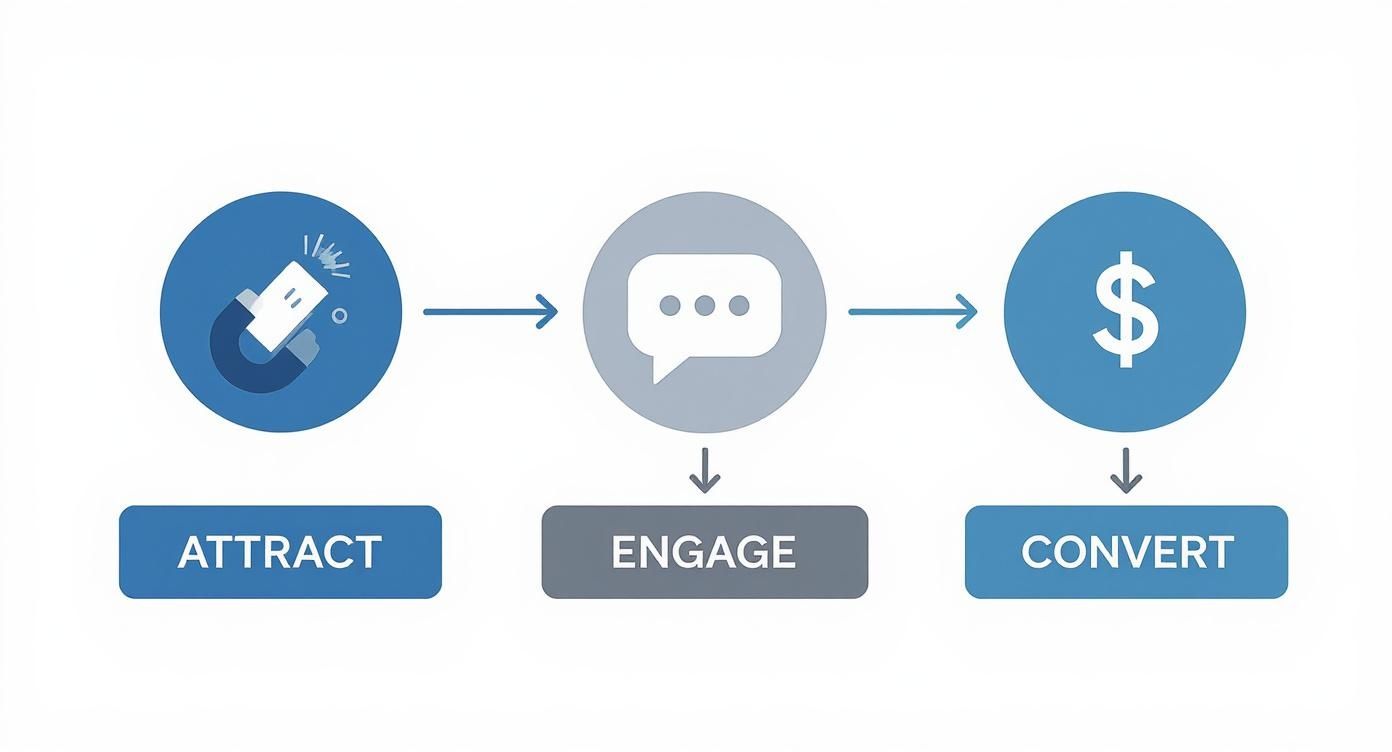
Each stage requires a different approach, moving a prospect from just browsing to signing on the dotted line.
Before diving into the specific tactics for each stage, it helps to see how the major channels stack up. Each one serves a different purpose and delivers a different type of lead.
Modern Lead Generation Channels At a Glance
| Channel | Primary Use Case | Potential Lead Quality |
|---|---|---|
| Local SEO | Capturing high-intent searchers looking for agents "near me." | High |
| Content Marketing | Building authority and attracting organic traffic with helpful guides. | Medium to High |
| Paid Social Ads | Hyper-targeting potential buyers/sellers by location and demographics. | Low to Medium |
| Video Marketing | Building personal connection and showcasing property tours. | High |
| Email Nurturing | Staying top-of-mind with past clients and warm leads. | Very High |
This table isn't exhaustive, but it gives you a solid framework for thinking about where to invest your time and money for the best results.
Key Components of a Modern Strategy
To build a robust pipeline, you need a multifaceted approach. Putting all your eggs in one basket leaves you vulnerable to market shifts. A balanced strategy always includes:
- A Professional Website: This is your digital storefront. It needs to be optimized for local search, feature compelling property listings, and offer content that cements your status as a local expert.
- Targeted Content Marketing: Think blog posts, neighborhood guides, and market updates. This stuff attracts organic traffic from search engines and serves as a natural lead magnet.
- Strategic Social Media Presence: Platforms like Facebook and Instagram are goldmines for building community and running hyper-targeted ad campaigns that reach people in specific zip codes.
A common mistake is treating lead generation as a checklist of separate tasks. It's not. It’s a cohesive system. When your website, content, and social media work together, they create a powerful and self-sustaining cycle of attraction and conversion.
This guide will break down each of these components, giving you actionable steps to build an effective system to generate leads for your real estate business. Instead of feeling overwhelmed, you'll learn to focus on the strategies that deliver the best return on your time and investment.
Build Your Digital Foundation with SEO and Content
Your website is your digital storefront, but if buyers and sellers can't find you on Google, you might as well be invisible. To generate leads that actually convert, you need a site that’s more than just a gallery of your current listings—it has to be an automated, lead-generating machine.
This all starts with a smart approach to Search Engine Optimization (SEO) and content marketing. The goal isn't just to stuff a few keywords onto a page. It's about creating genuinely valuable, hyperlocal content that pulls in high-intent organic traffic around the clock. Think of it as building a digital asset that works for you even when you aren't.
Create Hyperlocal Content That Attracts Leads
Winning at real estate SEO means thinking small—hyperlocal, to be exact. Sure, national market trends are interesting, but your potential clients are searching for information about their specific neighborhoods. When you create content that answers their local questions, you immediately position yourself as the go-to expert in your area.
This kind of content is a magnet for people who are deep into their buying or selling journey.
- Detailed Neighborhood Guides Go way beyond basic stats. Write about the local parks, the best coffee shops, school district ratings, and typical commute times. These are the details that help a potential buyer truly picture themselves living in that community.
- Monthly Market Update Blogs Break down local sales data, inventory levels, and pricing trends. This shows you have your finger on the pulse of the market and provides insights that both buyers and sellers are hungry for.
- Home Buying and Selling Checklists Create practical, downloadable resources like a "First-Time Home Buyer's Checklist" or a "Guide to Prepping Your Home for Sale." These are fantastic lead magnets because you're offering real value in exchange for an email.
The best real estate content answers the question behind the search. Someone looking for "best family neighborhoods in [Your City]" isn't just asking for a list—they're looking for reassurance, insider knowledge, and an expert they can trust to guide them.
This targeted strategy transforms your website from a static brochure into a dynamic resource. You can find more ideas in our deep dive on content marketing for real estate agents, which lays out a full plan.
Structure Your Website for Search Visibility
Great content is only half the battle. How your website is structured plays a massive role in how search engines like Google find, understand, and rank your pages. A well-organized site isn't just good for users; it also helps search engines see you as an authority on local real estate.
A proven method is to organize your content into logical "topic clusters." For instance, create a main "Buying" page that acts as a hub, linking out to more specific posts like "Understanding Closing Costs in [Your State]" or "How to Win a Bidding War in a Hot Market."
This structure signals to Google that you have deep expertise on the entire home-buying process. It not only boosts your SEO but also guides visitors to the information they need, keeping them on your site longer and making them much more likely to reach out.
Use Social Media for Pinpoint-Accurate Outreach
Let’s be honest: just posting your new listings on social media isn't a strategy. It's an announcement. The real power of platforms like Facebook and Instagram lies in building a local community and running ad campaigns with surgical precision. This is how you stop broadcasting and start connecting directly with potential clients in specific zip codes.
It's all about delivering the right message to the right person, exactly when they need to see it.

The trick is to move beyond hitting that simple "boost post" button and dive into the powerful tools inside the ad platforms. To really make an impact, you have to generate real leads from social media with a plan.
This isn't just a hunch; the data shows a clear shift. Paid channels now account for a solid 11% of all leads. Agents are increasingly using pay-per-click (PPC) ads to get in front of buyers and sellers, rather than just waiting for organic traffic to trickle in.
In fact, only 27% of marketers now rely on organic search as their main source of leads. While SEO is still a beast for driving traffic, paid ads are where you can get immediate, targeted results.
Crafting Ad Campaigns That Actually Convert
A winning social media ad starts with empathy. You need to get inside your audience's head and understand their pain points and what truly motivates them.
Are you talking to first-time homebuyers? Your ads should feel exciting and hopeful. Ditch the jargon and focus on the dream of ownership. A great angle is offering a downloadable "First-Time Buyer's Checklist."
If you're targeting potential sellers, your ads need to build trust and showcase your expertise. An ad that highlights your recent sales in their specific neighborhood is infinitely more powerful than a generic "Thinking of selling?" post. The goal is to create something that stops their scroll and makes them think, "This agent gets it."
Keep these elements in mind for your next campaign:
- Compelling Visuals: High-quality video walkthroughs, crisp professional photos, or even a simple, bold graphic that clearly states your offer (like "Get Your Free Home Valuation") work wonders.
- Benefit-Driven Copy: Don't just list features; sell the lifestyle. Instead of "a quiet cul-de-sac," try "the perfect, safe street for your kids to ride their bikes."
- A Crystal-Clear Call-to-Action (CTA): Tell people exactly what you want them to do next. Use direct, action-oriented phrases like "Learn More," "Download Your Free Guide," or "See Your Home's Value."
Defining Your Audience for Precision Targeting
This is where social media advertising leaves traditional marketing in the dust. You can get incredibly specific, moving beyond basic demographics to pinpoint your ideal clients with laser-like accuracy.
The most effective campaigns don't try to reach everyone. They focus on reaching the right people. Targeting homeowners in a specific zip code who have shown interest in Zillow is far more effective than a generic ad shown to an entire city.
Use the ad platform’s layering tools to build your perfect audience. Start with geography, like a 15-mile radius around your city. Then, start adding filters.
For example, you could target users aged 30-45 who are flagged as "likely to move" and have also shown interest in things like home improvement stores or mortgage calculators. This level of precision ensures your ad budget is spent on people who are actually in the market, dramatically improving your return on investment.
Mastering the Art of Lead Nurturing and Conversion
Getting a new lead in the door is just the first step. The real money—and where most agents either win or lose—is made in the follow-up. Turning a curious online browser into a signed client requires a smart, consistent nurturing process that builds trust and keeps you top-of-mind when they're finally ready to move.
Without a solid system, good leads will inevitably go cold. This is where a Customer Relationship Management (CRM) platform becomes an agent's best friend. A good CRM helps you organize every contact, track conversations, and automate your follow-up so no one ever falls through the cracks.
The numbers don't lie. Globally, real estate lead conversion rates hover around a brutal 2.9%. Let that sink in: for every 100 leads you generate, maybe three will turn into closed deals. It's a tough game.
But here's the kicker: agents who use effective lead nurturing can boost the likelihood of a sale by a staggering 47%. That's the difference between struggling and thriving, and it all comes down to having a well-managed pipeline. For more on this, check out these insightful lead generation statistics and their impact.
Building an Automated Follow-Up System
In lead conversion, speed and consistency are your secret weapons. The second an online lead hits your inbox, the clock is ticking. Your absolute mission should be to make contact within the first five minutes.
An automated system makes this possible, even when you're in a showing or closing. You can build out workflows that trigger specific actions based on how a lead finds you or what they do on your site.
- The Instant Response: As soon as a lead fills out a form, an automated text and email should fire off. The text can be simple and disarming: "Hi [First Name], this is [Your Name]. Just got your request for info on [Property Address] and I'm looking into it now. Are you free for a quick call in 15 minutes?"
- Long-Term Drip Campaigns: For those leads who aren't quite ready to pull the trigger, a long-term email drip campaign keeps you on their radar without being pushy. These automated sequences can send out monthly market updates, helpful articles about the buying process, or spotlights on local neighborhoods. If you're new to this, our complete guide to email marketing in real estate is a great place to start.
- Behavioral Triggers: This is where it gets really powerful. Modern CRMs can track what your leads are doing. Imagine getting an alert because a lead just revisited a specific listing on your site for the third time this week. That’s your cue to pick up the phone and make a personal call.
Here’s a classic mistake I see all the time: giving up way too soon. So many agents stop following up after two or three unanswered calls. But the data consistently shows it takes between eight and twelve touchpoints to actually turn a cold lead into a real conversation. Persistence pays off.
Proven Scripts for Every Stage
Having a system is half the battle; knowing what to say is the other half. While you should always be ready to adapt to the flow of the conversation, starting with a proven script can give you the confidence you need and ensure you hit all the key points.
Your first call isn't about the hard sell. It's about building rapport. Try an opener like this:
"Hi [First Name], I saw you were looking at some properties on my website. I'm not calling to sell you anything today, just wanted to introduce myself and offer to be a resource. What are you hoping to find in your next home?"
This simple shift in framing immediately lowers their guard and opens the door for a genuine conversation. From there, you can naturally transition to qualifying their timeline, budget, and motivations, moving them one crucial step closer to becoming your next client.
Supercharge Your Workflow with AI
Let's be honest, artificial intelligence used to sound like something out of a sci-fi movie. But today, it’s a real, boots-on-the-ground tool that’s completely changing how top agents generate leads. By weaving AI into your daily grind, you can automate the tedious stuff, spot opportunities others miss, and carve out a serious advantage in your market.
It all boils down to efficiency. Think about all the hours you spend on tasks that could be automated. AI handles those in minutes, giving you back the time you need to build relationships and close deals—the things that actually make you money.
Automate Engagement and Qualification
One of the biggest wins with AI is its ability to engage prospects the second they show interest. AI-powered chatbots on your website are like having a receptionist who works 24/7. They can greet visitors, answer the usual questions, and qualify leads on the spot.
Picture this: a potential buyer lands on your website at 11 PM on a Tuesday. Instead of them leaving a message you won't see until morning, a chatbot jumps in. It can ask about their budget, what neighborhoods they like, and their timeline. It can even book an intro call right into your calendar.
That speed is everything. Studies show that 78% of buyers go with the first agent who gets back to them, making that instant, AI-driven response a massive game-changer.
Predict Your Next Seller
AI is also getting incredibly good at predictive analytics. Certain platforms can crunch huge amounts of data—property records, demographic shifts, even online behavior—to pinpoint homeowners who are likely to sell soon.
This lets you shift from a "spray and pray" marketing strategy to a surgical one. Forget sending postcards to an entire zip code. Instead, you can focus your time and money on a hand-picked list of homeowners who are already showing signs of listing. If you're serious about leveraging AI for lead generation, this is where you can see some of the biggest returns.
AI doesn't replace the agent; it empowers them. It handles the data-sifting and initial outreach, allowing you to step in with your expertise at the most critical moments of the client journey.
Create Content in Minutes, Not Hours
Content creation is another area where AI is a huge time-saver. Modern AI writing assistants can draft compelling property descriptions, blog posts on local market trends, or a week's worth of social media captions in the time it takes to drink a coffee.
Just feed the tool a few key details about a property or a topic, and it generates well-written, SEO-friendly content that you can quickly polish and post. This consistency boosts your online presence and pulls in more organic leads, all without burning you out. To get started, you can explore this curated list of the top AI tools for real estate agents and find the right fit for your business.
Comparing AI Tools for Real Estate Agents
With so many AI tools flooding the market, it can be tough to figure out which ones are actually worth your time and money. The key is to match the tool to a specific bottleneck in your lead generation process, whether that's initial engagement, follow-up, or content creation.
Here’s a simple breakdown to help you navigate the options:
| AI Tool Type | Primary Function | Best For | Estimated Cost (Monthly) |
|---|---|---|---|
| AI Chatbots | 24/7 Website Engagement | Capturing and qualifying leads in real-time. | $50 - $300 |
| Predictive Analytics | Seller Lead Identification | Targeting homeowners likely to sell soon. | $100 - $500+ |
| AI Writing Assistants | Content Creation | Drafting property descriptions, blogs, and social posts. | $20 - $100 |
| CRM with AI | Lead Nurturing & Scoring | Automating follow-up and prioritizing hot leads. | $75 - $400 |
Ultimately, the best AI tool is the one you'll actually use consistently. Start with one that solves your most pressing problem, master it, and then expand your toolkit as you grow.
Common Questions About Generating Real Estate Leads
Diving into modern lead generation can feel like opening a can of worms. Even when you have a decent strategy mapped out, it's totally normal to have questions about timelines, costs, and what actually works on the ground. Let's clear up a few of the most common questions agents ask when they're getting serious about building their pipeline.

Think of this as your quick-reference guide. It’s here to nail down the key ideas we've covered and give you some solid takeaways for building a client list that lasts.
What Is the Most Cost-Effective Way to Generate Real Estate Leads
Paid ads on social media or Google get you speed, no doubt. But for the most bang for your buck long-term, nothing beats organic SEO and content marketing.
Building out a library of genuinely useful, local content—think detailed neighborhood guides, market updates, or "best schools in [Your Town]" articles—costs you time, not a ton of cash. This creates a powerful asset that pulls in free, high-intent traffic from search engines for years. Pair that with consistent (and free) social media engagement, and you've got a lead machine humming along with minimal financial outlay.
The real magic of organic marketing is that it compounds. An ad is gone the second you stop paying. A well-ranked blog post can keep bringing in leads month after month, long after you’ve hit "publish."
How Long Does It Take for Real Estate SEO to Work
With SEO, patience is everything. Realistically, you should expect to see tangible results—like ranking for local keywords and a noticeable bump in organic website traffic—within about four to six months.
Of course, this all depends on how fierce the competition is in your market and how consistently you're putting out good content. It's a slower burn than ads, for sure. But the leads you get from SEO are often pure gold because they come from people who are actively searching for exactly what you do.
How Quickly Should I Follow Up with a New Lead
Speed is the name of the game. When a new online lead comes in, your one and only goal should be to make contact within the first five minutes. Study after study confirms that your odds of qualifying that lead plummet after that tiny window closes.
After that first touch, you need a solid follow-up system. This isn't a one-and-done deal. It means multiple touchpoints across different channels (phone, text, and email) over the first few weeks. A proven cadence looks something like this:
- Daily contact for the first week.
- Weekly check-ins for the next month.
- Monthly touchpoints after that to stay on their radar.
A good CRM is non-negotiable here. It automates the whole process, making sure no one slips through the cracks and you always look like a pro.
Ready to find the perfect AI tools to supercharge your lead generation? At Tab Tab Labs, we curate and review the best solutions for real estate professionals. Explore our directory and find the right tools to automate your marketing, qualify prospects, and grow your business today at https://tabtablabs.com.