Email Marketing Real Estate: The Ultimate Guide to Real Estate Email Campaigns
Discover email marketing real estate strategies that boost opens, automate follow-ups, and turn leads into appointments.
By James Le
Any operator worth their salt knows a secret: the most valuable asset in their portfolio isn't a property, it's their contact list. A well-oiled email marketing for real estate machine is what turns that raw data—from probate lists to curious open house visitors—into predictable appointments and, ultimately, revenue.
This is about building a scalable system for growth, not just sending out a monthly newsletter and hoping for the best.
Why Your Email List Is Prime Real Estate
In a world of finicky social media algorithms and platforms that can change the rules overnight, email is the one direct channel you truly own. You're not renting space on someone else's platform; your email list is an asset you control completely.
That ownership is everything when it comes to building a reliable pipeline of buyers, sellers, and investors for the long haul.
The real magic isn't in just blasting out updates. It's in running targeted, automated sequences that feel like a one-on-one conversation, just scaled up. Think of it less like a marketing chore and more like building a dependable engine for your business.
The Numbers Don't Lie
If you're wondering if it's worth the effort, the data is pretty clear. Email marketing consistently delivers one of the highest returns of any channel, pulling in an average of $36 for every $1 spent. That’s a staggering 3,600% ROI.
For those of us in the real estate, design, and construction space, it gets even better. Teams in our sector see a 21.7% higher ROI compared to other industries. And as you scale up your operation, the returns get even bigger. Teams with 3-5 dedicated email marketers report a 42:1 ROI, a huge jump from the 30:1 for smaller teams. These email marketing statistics really drive home how a dedicated focus here directly pumps up your revenue.
For brokerages, investors, and high-volume teams, this isn't just an interesting stat—it's a strategic mandate. Pouring resources into a sophisticated email game isn't an expense; it's a direct investment in your pipeline and bottom line.
Ditch the Generic Newsletter
You unlock the true power of email marketing for real estate the moment you stop sending the same message to everyone. A generic monthly "market update" might keep your name out there, but it’s not going to convince a distressed homeowner to sell or nurture a ready-to-go buyer.
A truly effective email strategy is built on a few core ideas:
- Hyper-Segmentation: You have to slice up your list. Group contacts by specific criteria like their lead source (probate, tax lien, Zillow), their motivation level, or how they've interacted with your past emails.
- Personalized Automation: This is where you build email sequences that speak directly to the unique problems and goals of each segment. A first-time homebuyer needs a completely different conversation than a seasoned investor.
- Value-First Content: Stop selling and start helping. Send out genuinely useful information—local market reports, case studies, guides to the selling process—that builds trust and positions you as the go-to expert.
This is how you turn a passive list of contacts into an active, lead-generating machine. Instead of just spraying and praying for replies, you’re systematically guiding people from that first point of contact straight to a booked appointment. Your email list becomes a dynamic, revenue-generating asset that works for you 24/7.
Laying the Groundwork for High-Converting Campaigns
Before you even think about sending that first email, you need to lay the groundwork. This is the stuff that determines whether your campaigns will flourish or completely flop. Building a solid foundation for your email marketing real estate efforts isn't just about picking some fancy software; it's about creating a bulletproof system that turns raw data into actual, tangible appointments.
The whole process starts with your tools, and your Customer Relationship Management (CRM) system is the command center for all your lead data. It absolutely has to handle the unique quirks of real estate—from tracking distressed property details to managing nurture sequences that might last for months. A generic, off-the-shelf CRM just won't cut it when you need to slice and dice your leads by motivation level, property type, or follow-up status. If you're shopping around, we put together a guide on the best CRM for real estate agents that can help.
This whole flow, from messy data to a booked meeting, is a straightforward process once you have the right systems in place.
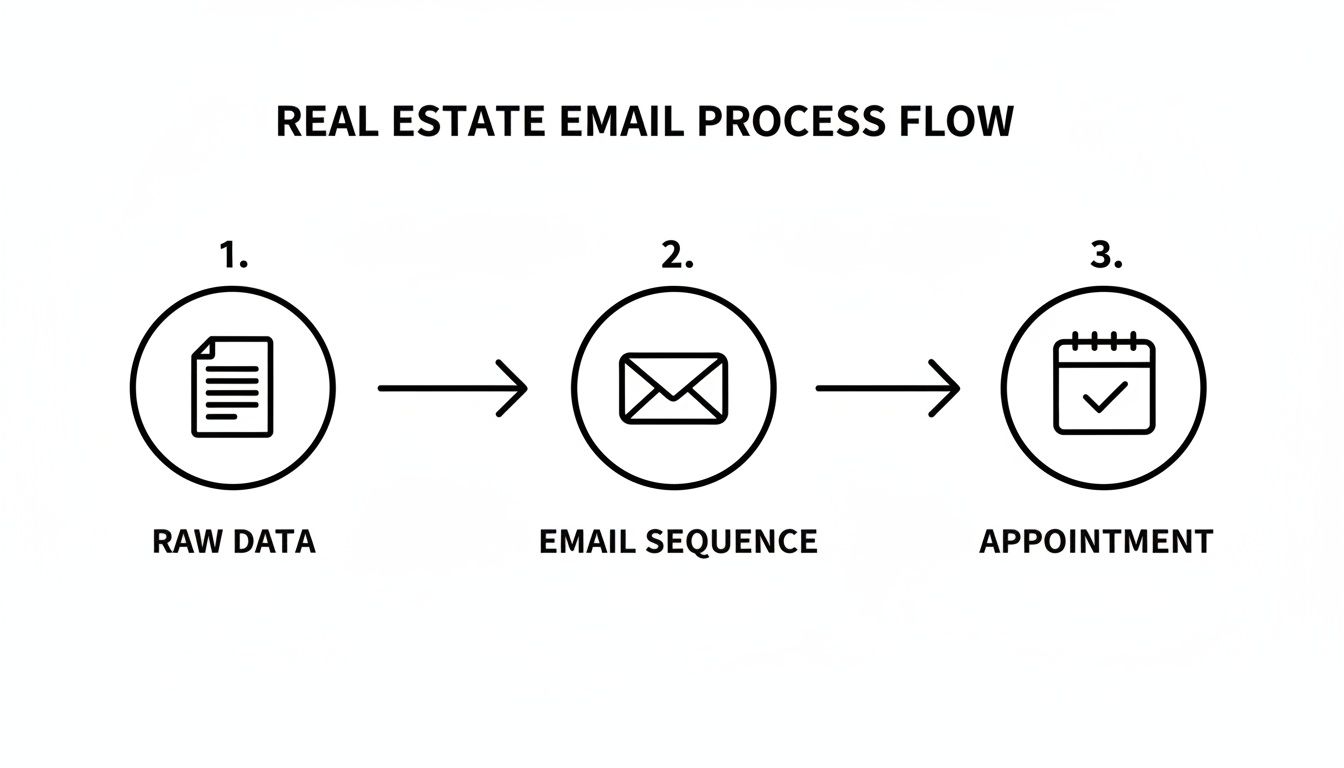
Think of a structured email system as the engine that powers your conversion machine, turning potential leads into real opportunities.
Sourcing Quality Leads and Maintaining List Hygiene
Let's be blunt: your email campaigns are only as good as the data you're working with. Sourcing high-quality leads is non-negotiable. This means you have to go beyond sketchy purchased lists and focus on data that signals genuine intent or motivation.
- Distressed Property Data: Digging into county records for things like tax liens, probates, or code violations gives you a direct line to motivated sellers, often before they even think about hitting the open market.
- Website Lead Capture: Simple forms on your site for property valuations, neighborhood reports, or new listing alerts are goldmines for engaged prospects.
- Open House and Event Sign-ups: These folks have already raised their hands and shown interest. They are prime candidates for targeted follow-up.
Once you have your list, keeping it clean is just as important. An unkempt list full of dead-end addresses, duplicates, and ghost contacts will absolutely tank your sender reputation and deliverability. Regular cleaning isn't optional. I recommend scrubbing your list at least quarterly to ditch bounced emails and contacts who haven't opened or clicked anything in over six months.
The Critical Inbox and Domain Warm-Up Process
You could write the most compelling email in the history of real estate, but it's completely worthless if it lands in the spam folder. This is where the domain and inbox warm-up process comes in, and it's a step too many people skip. Internet Service Providers (ISPs) like Google and Microsoft are naturally suspicious of new domains or email addresses that suddenly start blasting out tons of mail.
Warming up your domain is all about gradually increasing your sending volume over several weeks. It's a methodical approach that builds a positive sender reputation and proves to the ISPs that you're a legitimate sender, not a spammer trying to cause trouble.
Pro Tip: Your first sends should go to a small, hyper-engaged list of contacts you know will open them—think colleagues, past clients, or your mom. Those initial positive signals tell ISPs that your content is valuable.
Here’s a basic warm-up schedule to get you started:
- Week 1: Send 10-20 emails per day from each inbox. Make sure to mix it up between providers (Gmail, Outlook, Yahoo, etc.).
- Week 2: Bump it up to 20-40 emails per day. You can start introducing some light automation here, but keep the volume under control.
- Weeks 3-4: Gradually ramp up to 40-60 emails daily. By now, your domain should have a decent reputation, and you can start planning larger-scale campaigns.
To make sure your real estate emails consistently hit the inbox, getting a handle on your deliverability is key. For a much deeper dive into the technical side, check out these comprehensive guides on email deliverability. This foundational work—the right tools, a clean list, and a properly warmed-up infrastructure—is what makes scalable, effective email outreach possible.
Advanced Segmentation Strategies for Real Estate
Let’s be honest. Generic, one-size-fits-all email blasts are the fastest way to get your messages ignored, deleted, or worse, marked as spam.
The real power of email marketing for real estate is unlocked when you master segmentation—the art of slicing your contact list into smaller, more focused groups. This is what lets you send hyper-relevant messages. It’s the difference between shouting into a crowded stadium and having a meaningful, one-on-one conversation.
When you speak directly to a contact's specific situation, your engagement rates will skyrocket. A message that resonates with a first-time homebuyer is completely irrelevant to a seasoned investor hunting for their next multi-family property. Good segmentation ensures every email feels personal, valuable, and timely.

This targeted approach doesn't just boost your open and click rates. It builds trust, positioning you as the go-to expert who truly understands the unique needs of each person on your list.
Segmenting by Lead Type and Temperature
The most fundamental way to slice your database is by the contact's relationship to the market. Are they looking to buy, sell, invest, or just stay in the loop? This initial split dictates the entire tone and content of your communication from day one.
From there, you can layer on "lead temperature" to further refine your messaging. A “hot” lead who just requested a showing needs a much different, more urgent follow-up than a “cold” lead who downloaded your newsletter six months ago and hasn't engaged since.
Think of your list in terms of these primary buckets:
- Potential Buyers: This group can be broken down even further. Are they first-time homebuyers, luxury buyers, relocation leads, or folks looking for a specific property type like a condo or single-family home? Each needs a different conversation.
- Potential Sellers: These are homeowners who've shown some interest in selling, maybe by using your online home valuation tool or attending a seller-focused webinar.
- Real Estate Investors: This segment is laser-focused on ROI, cash flow, and market opportunities. Their content needs are analytical and packed with data.
- Sphere of Influence (SOI) & Past Clients: This is your goldmine for referrals and future business. It's all about long-term relationship nurturing to stay top-of-mind.
Targeting Motivation with Distressed Signals
For investors and agents chasing off-market deals, segmenting by motivation is where you find the gold. This strategy involves identifying homeowners who might need to sell quickly due to difficult life circumstances. Your messaging here has to be empathetic and solutions-oriented, never predatory.
These are not your typical seller leads; they are people facing genuinely challenging situations.
By segmenting based on distress signals, you can tailor your outreach to offer a specific solution to a specific problem. An email to a probate lead should be vastly different from one sent to a homeowner with a tax lien.
Here are a few powerful motivation-based segments to consider:
- Probate Leads: Contacts navigating the sale of an inherited property. Your emails should offer simple, hassle-free guidance on the probate process.
- Tax Delinquency: Homeowners who have fallen behind on property taxes. Your content can focus on options to resolve their debt, with selling being one of several potential solutions.
- Code Violations: Owners of properties with documented code violations may be overwhelmed or lack the funds for repairs, making them highly motivated sellers.
- Pre-Foreclosure: These homeowners are under immense pressure. Your communication must be sensitive, focusing on alternatives to foreclosure like a quick cash sale.
To put this into practice, here’s a look at how you might structure these segments.
Effective Real Estate List Segmentation Strategies
This table breaks down how to approach different audience segments, from their defining criteria to the kind of content that will actually get their attention.
| Segment | Criteria | Content Focus | Campaign Goal |
|---|---|---|---|
| First-Time Homebuyers | New leads from Zillow/Realtor.com, open house sign-ups, website registrations. | Step-by-step guides, mortgage basics, neighborhood comparisons, new listings under a certain price point. | Nurture and educate to build trust and schedule a buyer consultation. |
| Luxury Sellers | Home value > $1M, inquired about premium marketing, past luxury clients. | High-end market reports, case studies of luxury sales, concierge services, professional staging/photography. | Demonstrate expertise and secure a high-value listing appointment. |
| Absentee Owners | Out-of-state mailing address on tax records, owns multiple properties. | Cash flow analysis, property management tips, market appreciation data, "We Can Buy Your House As-Is" offers. | Motivate an off-market sale or establish a long-term investor relationship. |
| Cold Leads (90+ Days) | No email opens or clicks in the last 90 days. | Re-engagement campaigns with a strong offer, "Are you still looking?" polls, market update summaries. | Re-activate dormant leads or clean the list to improve deliverability. |
Tailoring your approach like this isn't just good marketing; it's how you build a resilient business that serves people's specific needs.
Leveraging Engagement History for Smarter Follow-Up
Your contacts' behavior tells you a story. By tracking how they interact with your emails, you can create dynamic segments that automate your follow-up and deliver precisely what they want, right when they want it.
This is a more advanced tactic that uses real-time data to drive your next move. It effectively turns your email list into an intelligent system that responds to user actions.
For example, you can create automated segments based on:
- Clicked a Specific Link: If someone clicks a link to "View Our Latest Luxury Listings," they should automatically be added to your "Luxury Buyer" segment to receive relevant high-end properties.
- Opened Multiple Emails in a Sequence: A contact who opens three or more emails in your "First-Time Homebuyer Guide" sequence is clearly engaged. This action could trigger a task in your CRM for a personal follow-up call.
- Has Not Opened in 90 Days: Create a "cold lead" segment to run re-engagement campaigns. You can send a final, compelling offer or a simple "Is this still the right email for you?" message to keep your list healthy.
By combining these strategies—segmenting by lead type, motivation, and engagement—you transform your email marketing for real estate from a simple broadcast tool into a precise, powerful engine for generating appointments and closing more deals.
Crafting Email Sequences That Convert Leads to Appointments
Alright, you've got a clean, perfectly segmented list. That's a huge win, but it's only half the battle. Now comes the fun part: turning that strategic advantage into scheduled appointments.
This isn't about blasting out a single, hopeful email and crossing your fingers. We're building a multi-touch narrative, a thoughtful conversation that guides a lead from initial curiosity to actual commitment. The key is to get inside their head.
Think about it: a homeowner in pre-foreclosure is under immense stress. They need a message of empathy and a clear path to a solution. A first-time homebuyer, on the other hand, is excited but probably overwhelmed. They're looking for educational content that builds their confidence. Every sequence you build has to solve a specific problem for a specific person.

This is more than just writing clever copy. It’s about understanding the psychology of your audience and structuring your outreach to build trust and prove your expertise with every single send.
The Anatomy of a High-Converting Sequence
Every effective email sequence I've seen, no matter who it's for, follows a similar psychological blueprint. You're essentially scripting a conversation designed to warm up a cold lead or nurture an existing one, moving them logically and emotionally toward taking that next step.
A proven structure usually hits these four key touchpoints:
- The Opener & Problem Agitation: Your first email needs to be direct, personal, and empathetic. Acknowledge their situation without being creepy or invasive. For a probate lead, this might mean offering simple condolences and a helpful, no-strings-attached resource.
- The Value-Add: This is where you give, give, give without asking for anything back. Send a useful guide, a local market report, or a checklist that speaks directly to their pain points. This move immediately positions you as a helpful expert, not just another salesperson.
- The Social Proof: People trust stories more than they trust claims. Share a brief, anonymized story of a client who was in a similar boat. Something like, "We recently helped a family in [Neighborhood] navigate this exact process, and they were able to..." makes your solution feel real and achievable.
- The Direct Ask: Once you’ve delivered value and built a foundation of trust, you've earned the right to ask for the appointment. Make your call-to-action (CTA) clear, low-friction, and focused on their benefit. Instead of a generic "Let's talk," try something like, "Are you open to a 15-minute call next week to walk through your options?"
Example Sequence for a Motivated Seller (Tax Lien)
Let's put this framework into action. Say you've identified a homeowner with a new tax lien. Your communication has to be sensitive and laser-focused on providing a solution.
Email 1 Subject: A quick question about your [City] property
- Content: Start with a brief, empathetic note acknowledging that property taxes can be a nightmare to navigate. Introduce yourself as a local specialist who helps homeowners explore all their options, then end with a simple, no-pressure question.
Email 2 Subject: A helpful guide for [City] homeowners
- Content: Here’s your value-add. Provide a link to a downloadable PDF: "5 Options for Handling a Property Tax Lien in [County]." This is pure, actionable help designed to empower them.
Email 3 Subject: How we helped a homeowner near [Local Landmark]
- Content: Time for social proof. Share a quick story about resolving a similar situation for another client, emphasizing the positive outcome (e.g., avoiding foreclosure, getting a fair cash offer they were happy with).
Email 4 Subject: 15 minutes to review your options?
- Content: Now for the direct but gentle CTA. "If you're still weighing your options for the property on [Street Name], I have some time next week for a confidential chat. Would Tuesday or Thursday work for you?"
This methodical approach respects the homeowner's situation while steadily making the case for why you're the right person to talk to. For a deeper look into structuring these campaigns, you can explore our detailed guide on the best real estate email drip campaign strategies.
The Psychology Behind Effective Copywriting
What you write is every bit as important as when you send it. Great real estate copywriting boils down to a few core principles that build connection and drive action.
- Empathy Over Urgency: This is non-negotiable, especially with distressed sellers. Your tone has to be one of understanding. Acknowledge their challenge before you ever mention your solution. Simple phrases like, "I can only imagine how challenging this situation must be," can build instant rapport.
- Demonstrate Expertise, Don't Just Claim It: Instead of calling yourself a "market expert," prove it. Use specific data points ("Homes in your zip code sold for an average of 5% over asking last month") or share an insightful piece of analysis they can't get anywhere else.
- Create Crystal-Clear Calls-to-Action: Don't make your reader guess what to do next. Be explicit and use action-oriented language: "Book a call," "Download the guide," or "Just reply to this email."
Remember, the goal of each email isn't to close the deal. It's to earn the right to send the next email. Every message is just a stepping stone toward a real conversation.
Ultimately, the data backs up this thoughtful approach. Real estate emails see an impressive open rate of 33.75%, and for cold outreach, hitting a response rate above 4% is considered excellent. These figures tell a clear story: personalized, value-driven campaigns are what make email marketing for real estate an absolute powerhouse for generating appointments. You can discover more insights about email engagement on OptinMonster.com.
When you combine proven sequence structures with empathetic, human-centric copywriting, you create a system that consistently turns cold data into warm conversations.
Automating Your Outreach for Scalable Growth
Look, effective email marketing in real estate doesn't mean you're chained to your keyboard, manually sending follow-ups all day. That's not a business; it's a job. The real goal is to build a system that nurtures leads 24/7 for you, without ever losing that critical personal touch.
This is where automation becomes your most valuable—and tireless—employee.
By setting up smart, automated workflows, you're essentially creating an "always-on" lead nurturing machine. It works in the background qualifying prospects and even booking appointments, freeing you up to focus on the stuff that actually makes you money—like negotiating offers and closing deals.
This is how you graduate from manual follow-up to scalable, predictable growth.
Building Trigger-Based Workflows
At its heart, automation runs on a simple "if this, then that" principle. A lead takes a specific action (or their data changes), and that action triggers a pre-built sequence of emails. It’s what makes every interaction feel timely and relevant.
Instead of remembering to send a check-in email, your system does the heavy lifting instantly. This immediate, tailored response can dramatically boost engagement and conversion rates, making sure you’re the first person a motivated lead thinks of.
Here are a few powerful trigger examples that work wonders in real estate:
- Behavioral Triggers: A contact clicks through to your website and views a specific luxury property page three times this week. That behavior can automatically enroll them in a sequence showcasing similar high-end listings and exclusive market reports for that neighborhood.
- Data-Based Triggers: A new distressed property lead—maybe from a tax lien list—gets added to your CRM. This can instantly trigger a sensitive, value-first email sequence designed to offer solutions and build trust, not just make a pitch.
- Time-Based Triggers: A lead has been sitting in your "long-term nurture" segment for 90 days without opening or clicking anything. This can trigger a re-engagement campaign with a punchy subject line, a compelling new offer, or a market update to bring them back into the conversation.
Integrating Your Systems for a Seamless Flow
Automation is at its most powerful when your entire tech stack—your CRM, email platform, and data sources—are all talking to each other. This creates a seamless flow of information that eliminates mind-numbing manual data entry and ensures no lead ever falls through the cracks.
When your systems are properly connected, a new lead from your website form can be instantly added to your CRM, tagged correctly, and enrolled in the right email workflow without you lifting a finger. It creates a frictionless experience for both you and your potential clients. For those just getting started, exploring marketing automation best practices can lay a solid foundation for building these integrated systems.
The scalability here is real and field-proven. One investor took a list of 10,000 records and, using 15 properly warmed-up inboxes, sent just 20 emails each per day. This methodical approach yielded a 4.7% response rate and a steady stream of motivated seller leads with minimal daily effort.
This is exactly why a well-planned, multi-account infrastructure is non-negotiable for serious operators who want to scale.
Designing Your First Automation Playbook
Getting started with automation doesn't have to feel like you're building a rocket ship. Just start with a single, high-impact scenario and build out from there.
Here's a simple, proven playbook for a "New Seller Lead" who just used your website's home valuation tool:
- Trigger: A homeowner submits your "What's My Home Worth?" form.
- Immediate Action: An email fires off instantly. It thanks them and lets them know their custom valuation is being prepared by a real person (you!).
- 24 Hours Later: A second email delivers their home valuation report. It also includes a helpful link to a blog post like, "3 Common Mistakes to Avoid When Selling in [Your City]."
- 3 Days Later: A third email lands in their inbox, this time sharing a brief case study of a successful sale in their neighborhood, complete with the final sale price. Social proof is powerful.
- 7 Days Later: A final, direct email asks if they're open to a 15-minute, no-obligation call to discuss their specific goals and the current market.
This simple workflow establishes your expertise, builds trust, and gently moves the lead toward an appointment—all without any manual work on your end. To dig deeper into how these kinds of email marketing automation strategies can streamline your outreach, check out that guide. By putting these systems in place, you're not just sending emails; you're building a powerful engine for scalable growth.
Your Top Real Estate Email Marketing Questions, Answered
Even when you've got a killer strategy mapped out, questions always come up when you're in the thick of it. That’s just the nature of email marketing in real estate.
This is where we’ll tackle some of the most common hurdles agents, investors, and brokers run into. Think of it as your go-to guide for troubleshooting and making smart decisions on the fly. Getting the little details right is what separates a campaign that fizzles out from one that consistently delivers.
What's the Best CRM for Real Estate Email Marketing?
There’s no magic bullet here. The "best" CRM really depends on your team's size, your budget, and what you’re trying to accomplish. The right platform becomes the central command for your entire outreach operation, so this isn't a decision to take lightly.
For solo agents or smaller teams just getting their feet wet, platforms like Follow Up Boss or LionDesk are fantastic. They’re built from the ground up for real estate, so you get features for tracking deals and managing relationships without needing a PhD to figure it out.
On the other hand, if you're a larger team, a brokerage, or an investor blasting out high-volume campaigns, you'll hit the limits of those tools pretty quickly. You need more horsepower. Systems like HubSpot bring much deeper automation and analytics to the table. For the true power users, a custom-built solution integrated with a dedicated sending platform gives you ultimate control and scalability.
How Often Should I Email My Real Estate Leads?
This is a classic "it depends" scenario. You’re walking a fine line between staying top-of-mind and becoming that annoying person who gets instantly marked as spam. The right cadence is all about the type of lead you're talking to.
- Hot & Motivated Leads: Think distressed sellers or fresh Zillow inquiries. For these folks, you need to act fast. An initial burst of 3-5 emails over the first two weeks is a great starting point. It keeps the momentum going while they’re in decision-making mode.
- Sphere of Influence (SOI) & Past Clients: These people already know, like, and trust you. The goal here is long-term nurturing. A high-value monthly newsletter, sprinkled with the occasional market update when something big happens, is perfect.
- Long-Term Nurture (General Buyers/Sellers): These are the leads who raised their hand but aren't ready to pull the trigger. A bi-weekly or monthly email with genuinely helpful content (think market trends, home maintenance tips, neighborhood guides) keeps you on their radar until the time is right.
Here's the golden rule: Watch your numbers like a hawk. If you see open and click-through rates start to tank for a specific audience, that's your cue to pull back. They're telling you it's too much.
How Can I Stop My Emails From Going to Spam?
Landing in the inbox is half the battle, and it all comes down to your sender reputation. If Google and Microsoft think you're a spammer, your emails are dead on arrival.
First things first, you absolutely must warm up your email domain and inboxes properly. This means starting slow and gradually increasing your sending volume over time. It’s a process that proves to the big email providers that you're a legitimate sender, not some fly-by-night operation. Skipping this is the single fastest way to kill a campaign before it even starts.
Next up is list hygiene. You have to keep your database clean. That means regularly scrubbing out invalid email addresses and contacts who haven't opened anything in months. A high bounce rate is a massive red flag that will wreck your deliverability.
Finally, look at your actual email content. Ditch the spammy trigger words in subject lines ("free," "act now!!!!"). Personalize the message so it doesn't feel like a generic blast. And, most importantly, every single email needs a clear and simple unsubscribe link. It's not just a good idea—it's the law, and it protects you.
At Tab Tab Labs, we do things differently. We turn raw, off-market distressed property data into a predictable flow of qualified appointments booked right on your calendar. Our AI engine handles the grunt work—scraping, qualifying, and booking—so your team can focus on what they do best: closing deals.
Ready to stop fighting over stale MLS leads and own your market?