Absentee Owners List: Unlock Motivated Seller Leads Today (Absentee Owners List)
Discover the absentee owners list and turn it into motivated seller leads. Learn sourcing, segmentation, and outreach strategies for off-market deals.
By James Le
In the hyper-competitive world of real estate, the sharpest operators are always looking for an edge. While everyone else is fighting over the same scarce listings on the MLS, a savvy few are tapping into a goldmine of off-market deals. Their secret? Absentee owner lists.
An absentee owner list is just a collection of properties where the owner's mailing address doesn't match the property's physical address. That simple mismatch is a powerful signal. It tells you the owner lives somewhere else, and that distance often creates a powerful motivation to sell.
Why an Absentee Owner List Is Your Unfair Advantage
This isn't just another lead list to dump into your CRM. It's a strategic asset. Think about it: you get a direct line to a pool of property owners whose situations are fundamentally different from the average homeowner. You're not just finding houses; you're finding stories, problems, and compelling reasons to make a deal.
These owners aren't some uniform bloc of faceless investors. They're a diverse group, and understanding their individual circumstances is the key to connecting with them effectively.
The Real People Behind the Properties
When you hear "absentee owner," it's easy to picture a slick, out-of-state tycoon with a massive portfolio. And sure, some fit that bill. But the reality is far more varied and, frankly, more interesting. Many are "accidental landlords" who never planned on owning a rental in the first place.
You'll find people from all walks of life whose circumstances have simply changed:
- Tired Landlords: These are folks who have spent years chasing rent, fixing toilets, and dealing with tenant drama. They're burned out. For them, a fair cash offer isn't just a transaction; it's a ticket to freedom.
- Inherited Property Owners: Someone inherits a house from a relative, often in a completely different city or state. They're dealing with grief, and now they're stuck with the financial and emotional weight of a property they don't want and can't easily manage. A quick, hassle-free sale is often the perfect solution.
- Vacation Homeowners: The dream getaway can turn into a financial nightmare. Life happens—divorce, a job loss, or retirement changes the equation, and that second home becomes a liability they need to unload.
- Relocated Professionals: They moved for a great job opportunity and decided to rent out their old place. But managing a property from hundreds of miles away is a bigger headache than they ever imagined.
To give you a clearer picture, let's break down the common categories and what really drives their decisions.
Absentee Owner Categories and Motivations
The table below breaks down the primary types of absentee owners and the specific triggers that often lead them to sell. Recognizing these patterns is crucial for tailoring your outreach.
| Owner Type | Primary Characteristics | Common Selling Triggers |
|---|---|---|
| Accidental Landlord | Inherited the property; didn't plan to be a landlord. | Emotional attachment is low; managing a distant property is a hassle. |
| Tired Landlord | Long-term owner, often with multiple properties. | Burnout from tenant issues, costly repairs, and constant management. |
| Out-of-State Investor | Owns a portfolio for investment purposes. | Cashing out equity, poor property performance, simplifying their portfolio. |
| Vacation Homeowner | Property is a second home, used infrequently. | Change in financial status, divorce, or the home is no longer used. |
| Relocated Professional | Moved for work but kept the original home as a rental. | Difficulty with long-distance management, desire to buy in their new city. |
Understanding these nuances helps you move from generic marketing blasts to targeted, empathetic conversations that actually resonate.
Why This Strategy Is So Powerful Right Now
Targeting absentee owners works because their decision-making process is different. They typically lack the deep emotional connection someone has to their primary residence. For them, the property is an asset on a balance sheet, which leads to a more logical, less emotional negotiation.
Recent market shifts have poured fuel on this fire. Since 2020, there's been a significant uptick in absentee ownership across the country. An analysis by ATTOM, highlighted in an NBC News report, found that the share of homes sold to absentee owners climbed in 228 out of 307 zip codes in major metro areas. That’s a 74% increase in these types of deals.
And here's the kicker: about 75% of all investor purchases are made with cash. This means you're dealing with a pool of sellers who are often equity-rich and ready to make a move. You can find more great insights on these trends from the team at Espresso Agent.
By focusing your efforts on an absentee owner list, you sidestep the fierce competition of the open market. You're not just finding properties; you're connecting with people who have a clear, and often urgent, reason to consider an offer.
Ultimately, this isn't about chasing one-off deals. It's about building a predictable, scalable pipeline of motivated sellers. Instead of waiting for the phone to ring, you proactively create your own opportunities, giving you control over your deal flow and your bottom line.
How to Build Your Own Absentee Owners List
Buying a generic, pre-made list can feel like a shortcut, but it's often a fast track to disappointment. I've seen it happen time and again. Those lists are usually stale, riddled with inaccuracies, and have already been sold to every other investor and agent in your market.
The real edge comes from building your own targeted absentee owners list. This approach gives you an exclusive pipeline of prospects your competition is probably overlooking. When you get your hands dirty and build the list yourself, you're in complete control of the data quality from day one.
Mastering this process is a huge piece of any serious strategy for effective lead generation strategies, especially when your goal is to find truly motivated sellers. It all starts with public records, which are an absolute goldmine if you know where to dig.
The whole game is about moving from simple identification to understanding the financial triggers that create real opportunity.
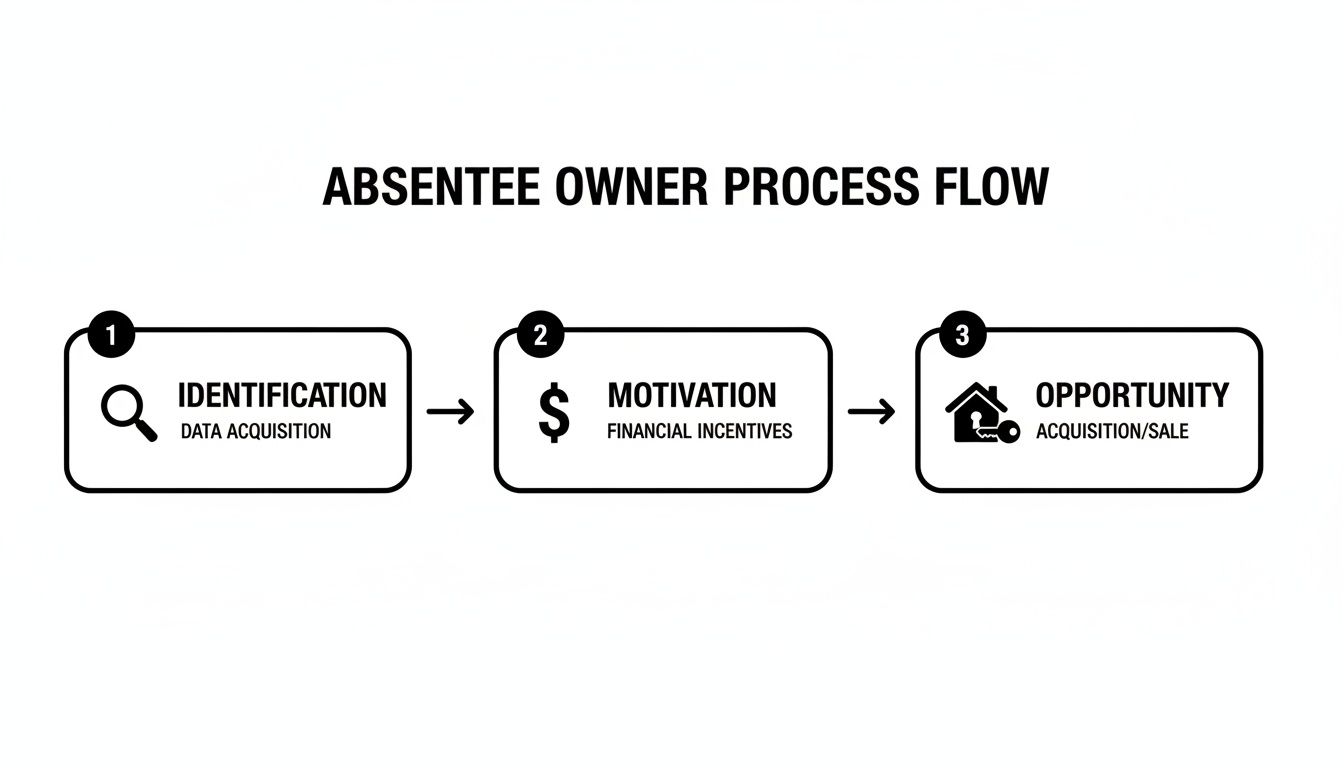
As you can see, finding names is just the first step. The real magic is in understanding the story behind the data—the motivations that turn a property owner into someone who's ready to sell.
Sourcing Data Directly from Public Records
Your best, most reliable starting point is your local county's public records, specifically the tax assessor or property appraiser's website. This is the cheapest way to get the job done, and it gives you access to the freshest data available.
The entire hunt boils down to finding one key discrepancy: a property where the owner's mailing address is different from the property's physical address. This simple mismatch is the classic signature of an absentee owner.
Think about it this way: an agent targeting the "Greenwood" neighborhood could hop on the county assessor's portal. They might run a search for all single-family homes in that area. The results will usually show both the "Property Address" and a "Mailing Address" for tax bills. When those two don't match, you've hit pay dirt.
Steps for Manual Data Compilation
Putting this data together by hand definitely takes some patience, but the quality of the list you get is worth the effort. Here’s a workflow that I've used many times:
- Define Your Target Area: Don't try to boil the ocean. Start small with a specific zip code, a neighborhood you know well, or even a particular street. This keeps things manageable.
- Access County Records: Head over to your county's tax assessor or property records website. Most of them have free online portals you can search.
- Perform a Search: Use the site's search tools to pull up properties in your chosen area. Look for an option to export the results into a spreadsheet (CSV or Excel is perfect).
- Identify the Discrepancy: In your spreadsheet, you really only care about two columns: "Property Address" and "Owner Mailing Address." Your job is to filter or sort this sheet to find every row where those two columns are not the same.
This hands-on process gives you a raw, powerful list of local, out-of-county, and even out-of-state absentee owners that nobody else has.
Leveraging Paid Data Providers
While doing it yourself is powerful, it's also a grind, especially if you're trying to scale up. Paid data providers are the answer when you need to move faster. They do the heavy lifting of pulling public records from thousands of counties into one clean, searchable database.
These platforms let you go way beyond a simple address mismatch. You can start layering on some really sophisticated filters:
- Length of Ownership: Zero in on owners who have held a property for 5+ years.
- Estimated Equity: Filter for properties with high equity, which often means the owner has the financial flexibility to make a deal.
- Property Type: Get laser-focused on single-family homes, multi-family units, or vacant land.
Here's a key insight from years in the business: the average investor landlord often cashes out within 3 to 5 years. Why? They get burned out from the headaches of property management. Knowing this helps you prioritize owners who are likely approaching that "I'm done with this" phase.
Some of the best services cross-reference multiple public databases to find these address discrepancies, claiming over 90% accuracy in identifying absentee owners. This is a huge leap from the manual approach.
Verifying and Cleaning Your List
Here's the hard truth: whether you build the list yourself or buy it, the data is never going to be 100% perfect. This is why the final step is also the most important: cleaning and verifying your list. You have to do this to avoid wasting time and money on bad leads.
Verification means confirming who actually owns the property and—crucially—finding their real contact info, like phone numbers and email addresses.
This enrichment process is called skip tracing, and it's non-negotiable if you plan on doing anything more than sending direct mail. For a much deeper look at this, check out our guide on finding the best skip tracing service to power up your data. A clean, verified, and well-researched list is the bedrock of any successful off-market acquisition strategy.
Segmenting Your List for Smarter Outreach
So you've got your hands on a big, raw absentee owners list. That's a great start, but in its raw form, it’s really just a pile of data. It holds potential, sure, but without some structure, you're looking at a pretty inefficient and overwhelming outreach process.
The real magic happens when you start segmenting—slicing that master list into smaller, much more targeted groups based on specific criteria. This is how you stop shouting into the void with generic marketing and start having personalized conversations that actually get a response.
Think of it like this: You could cast a giant net into the ocean and hope you catch something worthwhile, or you could use a specific lure in a spot where you know a certain type of fish gathers. Segmentation is your lure. It lets you craft a message that speaks directly to the unique motivations of each group of owners.
Key Criteria for Effective Segmentation
Your goal here is to spot the patterns that signal a higher chance of selling. Instead of treating every owner the same, you can pour your energy into the leads with the most potential. Here are the filters I’ve found most impactful over the years.
- Owner Location: This is the first and most fundamental layer of segmentation. Grouping owners by how close they live to the property—local, out-of-county, or out-of-state—is a game-changer. An out-of-state owner almost always has bigger management headaches, making them an immediate top-tier prospect.
- Length of Ownership: Someone who has owned a property for 7-10 years or more is often sitting on a nice chunk of equity. They’re also far more likely to be feeling the burn of landlord fatigue, which makes them much more open to a simple, hassle-free offer.
- Estimated Equity: High equity is a massive motivator. An owner with 50% or more equity has the financial flexibility to sell without worrying about being underwater. This gives you way more room to negotiate a deal that works for everyone.
- Property Type: Are you hunting for single-family homes, duplexes, or vacant land? Separating your list by property type is crucial for making sure your outreach is actually relevant to the asset they own.
To really dial in your messaging and boost response rates, a solid understanding audience segmentation is non-negotiable. It’s the difference between a cold call and a warm conversation.
The Psychology Behind Different Owner Segments
Segmentation isn't just about crunching numbers; it's about getting inside the heads of these owners. An out-of-state landlord with high equity who has owned their property for a decade is a completely different person than a local owner who just bought a rental two years ago.
For the out-of-state owner, that distance creates a real disconnect. They can't just swing by to check on a leaky faucet or meet a new tenant. Every little issue becomes a logistical nightmare, cranking up their stress levels and making a clean, easy sale look incredibly appealing.
On the other hand, a local owner has more direct control and a much higher tolerance for the day-to-day hassles. They’re still a good lead, of course, but their motivation is rarely as urgent.
By layering these filters, you can build a profile of your "perfect prospect." For instance, an out-of-state owner of a single-family rental for over 10 years with more than 60% equity? That’s arguably the most motivated seller you can find.
Practical Steps for Segmenting Your List
You don't need fancy, expensive software to get going. A simple spreadsheet can be an incredibly powerful tool for slicing and dicing your absentee owner list.
Just use the filter function in Excel or Google Sheets to start creating your sub-lists. I like to start by creating a column for "Owner Location" and tagging each lead as "Local," "Out-of-County," or "Out-of-State." From there, you can apply more filters for things like equity percentage and years of ownership. This process lets you build hyper-targeted lists for each of your marketing campaigns.
The absentee owner world is pretty diverse. Industry data shows that tenant-occupied properties make up about 60% of these lists. Inherited properties are another big slice at 20%, and vacation homes typically account for around 15%. When your list is enriched with details like equity levels (which average 65% across the board), you can pinpoint opportunities to buy properties at a significant discount.
By properly segmenting your data, you turn a simple list into a strategic weapon, letting you focus your time, money, and energy where they'll make the biggest impact.
Crafting Outreach That Actually Gets a Response
Okay, so you've got your segmented absentee owners list. Now for the fun part: turning that raw data into actual conversations. This is where your strategy hits the pavement.
The goal isn't just to blast out messages; it's to start a dialogue that feels personal, solves a potential problem for the owner, and gets them to reply. Generic templates are a one-way ticket to the trash folder. What works is a multi-channel approach that respects the owner's time and speaks directly to their situation.

A smart mix of direct mail, phone calls, and email can make a massive difference in your connection rate. Each channel has its own vibe, and when you layer them, they create a powerful sequence that keeps you top of mind without being annoying.
Stand Out in the Mailbox with Direct Mail
In a world drowning in digital noise, something you can physically hold has a surprising amount of punch. Direct mail is still a killer way to reach absentee owners, but only if you do it right. Your mailer has to scream "not junk mail" and signal value from the second they see it.
Direct Mail Formats That Work:
- Handwritten Notes: Seriously, nothing beats the personal touch of a handwritten note on decent stationery. It's almost guaranteed to be opened and read. Keep it short and sweet, reference their specific property address, and offer a simple, no-pressure way to chat.
- Eye-Catching Postcards: A well-designed postcard gets your message across in a single glance. Use a high-quality photo of a similar property nearby or a bold headline like, "Thinking of selling your property on [Street Name]?"
- Local Market Updates: Send a letter that actually helps them. Think a one-page report on recent sales in their property's neighborhood. This move positions you as a helpful expert, not just another person asking for their business.
The real key here is consistency. A single mailer is easy to forget. You need to plan a sequence of 3-5 touches over several months to build that crucial familiarity and trust.
Mastering the Empathetic Cold Call
Cold calling can feel like a nightmare, I get it. But for absentee owners, it’s one of the most direct and effective ways to connect. The secret is to flip your mindset from "selling" to "helping." Your script—if you even use one—should be built around empathy and curiosity.
When you get them on the phone, acknowledge their situation right away. A great opener is something like:
"Hi [Owner's Name], my name is [Your Name]. I know this call is out of the blue, but I was calling about your property over on [Property Address]. I specialize in helping owners who manage properties from a distance and just wanted to see if you had any plans for it."
This approach immediately shows you've done your homework and understand their specific challenge as an out-of-town owner. It frames the entire conversation around their needs, not your commission.
Your goal on that first call isn't to close a deal. It's to start a conversation, listen for their pain points, and figure out if you can genuinely help. Be prepared to hear "no" a lot, and always end the call professionally. Leave the door open for another time.
Email Strategies That Actually Land in the Inbox
Email is a fantastic, low-cost tool to back up your mail and phone efforts. But to have any chance, your message has to slice through an insane amount of clutter. That battle starts with a compelling subject line that doesn't scream "SPAM!"
Subject Lines That Get Opened:
- Question about your property at [Property Address] (Specific and sparks curiosity)
- A quick thought on your [City] rental (Feels personal and informal)
- [Neighborhood Name] market update (Offers immediate value)
Once they open it, keep the email incredibly brief. Long, dense paragraphs are DOA. Use short sentences, ask a clear question, and make it ridiculously easy for them to reply.
For those looking to get more systematic with their follow-up, our guide on building a real estate email drip campaign is a complete playbook for putting these touches on autopilot.
Deciding which channels to focus on depends on your market, your budget, and your personality. Here's a quick breakdown of how these channels typically stack up against each other.
Outreach Channel Performance Comparison
| Outreach Channel | Pros | Cons | Average Response Rate |
|---|---|---|---|
| Direct Mail | High visibility; feels personal. Stands out from digital noise. | Higher cost per touch; slower response time. Hard to track opens. | 1-3% |
| Cold Calling | Immediate feedback and conversation. Allows for personal connection. | Time-intensive; high rejection rate. Can be perceived as intrusive. | 1-2% (contact-to-lead) |
| Email Marketing | Low cost and scalable. Easy to track and automate. | Very low open rates; often lost in spam or clutter. | <1% (direct response) |
As you can see, no single channel is a magic bullet. The real power comes from layering these efforts. For instance, send a postcard, follow up with a phone call a week later, and then send a quick email referencing your call. This creates a cohesive story, builds name recognition, and dramatically increases your odds of getting a response from your absentee owners list.
Automating Your Prospecting to Scale Success
If you're still prospecting your absentee owners list by hand, you've probably hit a wall. There are only so many hours in the day to stuff envelopes, dial numbers, and peck out one-off emails. That kind of manual grind is a fast track to burnout and, even worse, a lumpy and inconsistent deal flow.
The only way to break through that ceiling is to build a smart, automated system that does the heavy lifting for you—even while you're out closing deals. You're not just making tasks easier; you're building a lead generation engine that consistently warms up prospects without needing you to be hands-on 24/7.

Integrating Your List with a CRM
Let's get one thing straight: your CRM should be the central nervous system for your entire prospecting operation. Trying to track everything in a spreadsheet is a recipe for disaster. Leads fall through the cracks, important follow-ups get missed, and valuable data just evaporates. For anyone serious about scaling, integrating your absentee owner list directly into a CRM isn't optional—it's foundational.
When your CRM and your list are properly connected, you can:
- Track Every Single Interaction: Every call, email, and direct mail piece is automatically logged on the prospect's record. No more guessing games.
- Automate Your Follow-Up: You can set up simple rules that trigger follow-up tasks or entire email sequences after a certain amount of time or a specific interaction.
- Segment on the Fly: Use tags and custom fields to slice and dice your list right inside the CRM. This is huge for running more targeted, personal outreach campaigns.
This setup gives you a single source of truth for every lead. You stop chasing people reactively and start engaging them with a proactive, repeatable system.
Leveraging Automation Tools for Outreach
Once your CRM is the brain of the operation, you need tools that act as the hands and feet. This is where specialized software comes in to handle the soul-crushing, repetitive parts of outreach. The goal is to connect with more owners in far less time.
Automated Direct Mail Services Forget about licking stamps. Services like PostcardMania or Ballpoint Marketing let you set up "drip" direct mail campaigns. You design your mailers, upload your list, and the service handles the printing and sending based on your schedule. It’s a guaranteed way to stay top-of-mind.
Email Drip Campaign Software Tools like Mailchimp or ActiveCampaign are non-negotiable for email. You can build out multi-step sequences that kick off the moment a new absentee owner gets added to your list. Imagine this: a new lead gets a welcome email, a week later they receive a local market report, and two weeks after that, a relevant case study—all without you lifting a finger. If you want to go deeper on this, check out our guide on marketing automation best practices.
Smart Dialers If you're hitting the phones, a smart dialer is a game-changer. These platforms can dial multiple numbers at once and only connect you when a real person picks up. We're talking about tripling or even quadrupling the number of actual conversations you can have in an hour.
The Role of Skip Tracing in Automation
Here’s the hard truth: automation is only as good as the data you feed it. If you're trying to automate outreach to an absentee list full of dead-end phone numbers and bogus emails, you're just automating failure at scale. This is precisely why skip tracing services are a critical part of a modern tech stack.
A killer workflow is integrating a skip tracing service with your CRM through an API. When a new absentee owner record is added, it can automatically trigger a skip trace to find and verify phone numbers and emails before that lead ever enters an outreach campaign.
This simple step ensures your automated systems are firing on all cylinders with the most accurate contact info possible. Your connection rates will soar, and the ROI on your marketing spend will look a whole lot better. When you combine a clean, enriched list with a powerful CRM and outreach automation, you're not just prospecting anymore—you're building a predictable pipeline of motivated seller leads.
A Few Common Questions About Absentee Owner Lists
Once you start digging into absentee owner prospecting, you'll quickly run into a few practical questions. It’s one thing to have a strategy, but it’s another to handle the nitty-gritty details. Let's clear up the most common hurdles so you can prospect with confidence.
Think of this as your go-to guide for the real-world challenges that come with any good absentee owners list.
How Often Should I Refresh My List for Accuracy?
Data gets stale way faster than most people realize. Properties change hands, owners relocate, and phone numbers get disconnected. If you're not careful, you'll end up pouring marketing dollars down the drain chasing ghosts.
My rule of thumb? Refresh your absentee owners list at least every 90 days.
A quarterly update is the sweet spot. It ensures you’re working with the most current ownership data without breaking the bank. This keeps your outreach sharp, your mailers landing in the right mailboxes, and your calls connecting to actual owners.
What Are the Do Not Call List Rules I Need to Follow?
This is a big one, so pay close attention. Following the National Do Not Call (DNC) Registry isn't optional—it's the law. Before you even think about picking up the phone, you absolutely must scrub your list against the federal DNC database. Getting this wrong can lead to fines that will make your head spin.
Don't ever assume you're covered. "I didn't know" is not a legal defense. You need to check both federal and state-specific DNC rules, as some states are even stricter. Your best bet is to use a professional dialing system or a CRM with compliance features baked right in to handle this for you.
Is It Better to Buy a Pre-Made List or Build My Own?
Ah, the classic "buy versus build" debate. Honestly, the best answer depends entirely on your resources, your market, and how you plan to operate. There are pros and cons to each.
- Buying a list is all about speed and convenience. It’s a fantastic way to get data in your hands today and start your outreach tomorrow. The major downside? That list has been sold to who-knows-how-many of your competitors. You're fishing in a crowded pond.
- Building your own list straight from public records is a grind, no doubt about it. But the payoff is a completely exclusive, highly targeted dataset that nobody else has. You get to control the quality from day one and zero in on specific criteria that off-the-shelf lists just can't offer.
For most serious investors I know, a hybrid approach wins out. Start by meticulously building a core list from public records in your primary farm area. Then, use purchased data to either supplement that list with phone numbers and emails or to run broader, top-of-funnel campaigns. It gives you the best of both worlds: quality and scale.
Ready to stop fighting over stale, recycled lists and start building a predictable pipeline of exclusive, motivated seller leads? Tab Tab Labs combines proprietary county-level data with powerful automation to deliver pre-qualified appointments directly to your calendar. See how our Distressed Appointments Engine can transform your business.