Real Estate Agent Prospecting: Real Estate Agent Prospecting Masterclass
Discover real estate agent prospecting strategies that combine data-driven targeting, multi-channel outreach, and AI automation to build a predictable pipeline.
By James Le
Real estate prospecting is just a fancy term for actively hunting for new clients. It's the difference between waiting for the phone to ring and making it ring yourself. This means getting out there—calling people, knocking on doors, sending mail—to find potential buyers and sellers, build relationships, and create a predictable stream of business. Honestly, it’s the engine that keeps a real estate career running long-term.
Building Your Prospecting Foundation With Data
Forget the old "spray and pray" method of blanketing a zip code with flyers and hoping something sticks. That’s a fast way to burn through your marketing budget. Today’s sharpest agents start with surgical precision, using data to find highly motivated sellers before they even think about listing. This is all about building a reliable pipeline by focusing on the why behind a move, not just the where.
This shift isn't just a "nice to have" anymore; it's critical. The market has changed dramatically, and the old playbooks are gathering dust for a reason. For years, agents built their entire business around first-time homebuyers. But that well is drying up.
First-time buyers now make up a measly 21% of the market—the lowest it's been since they started tracking this stuff back in 1981. This stat alone should be a wake-up call. Your prospecting has to evolve. Instead of broad-stroke campaigns, you need to get smarter, segmenting your lists based on real motivation, equity, and financial situations. Agents who pivot to focus on downsizers, equity-rich owners, and cash buyers are the ones winning right now.
Differentiating Between Generic and High-Intent Data
The real secret to effective prospecting lies in knowing the difference between a simple list and a source of genuine market intelligence. A generic list—say, every homeowner in a 90210—tells you nothing about who’s actually thinking of selling. It’s a pure numbers game, and the conversion rates are brutal.
High-intent data, on the other hand, is where the gold is. It’s packed with signals that point to a major life event or a financial situation that forces a homeowner’s hand. We’re talking about things like:
- Tax Liens: Financial distress is a powerful motivator. A tax lien often means the owner needs to sell quickly to settle up.
- Probates: When a property goes into an estate, the heirs are usually looking to liquidate it, not manage it from afar.
- Code Violations: This can signal a neglected property or an owner who's overwhelmed. Either way, they’re often open to selling.
- Foreclosure Filings: These homeowners are under immense pressure to sell before the bank takes over. They need a solution, fast.
Tapping into these sources gives you a direct line to motivated sellers, putting you miles ahead of the competition still working off stale, generic lists.
Creating Your Ideal Client Profile
Once you’ve got your hands on high-intent data, the real work begins: crafting your Ideal Client Profile (ICP). An ICP isn't just about demographics; it’s a laser-focused definition of the exact prospect you're best suited to help. It digs deep into the "why" behind their move.
For example, a solid ICP might be: "Empty nesters in the Northwood neighborhood with over 50% equity, living in homes larger than 3,000 sq ft." Another great one is targeting investors by using comprehensive absentee owner lists to find landlords ready to offload their portfolios.
This level of detail makes every single piece of outreach—every call, every mailer—infinitely more relevant and effective. And once you've nailed down who you're targeting, you can learn how to generate leads from LinkedIn effectively to connect with those specific profiles, which really solidifies your prospecting foundation.
Designing a Multi-Channel Outreach Cadence
Having a pristine list of high-intent prospects is a huge advantage, but it's really only half the battle. Without a systematic plan of attack, even the best data will just sit there and go stale. This is where a multi-channel outreach cadence comes in—it’s your playbook for making contact, staying top-of-mind, and turning a cold lead into a warm conversation.
A great cadence isn't about spamming people across every platform imaginable. It's about creating a series of strategic, value-driven touchpoints that build on each other. A cold call might be your opening move, but a follow-up email with a relevant market report and a thoughtful direct mail piece a week later? That reinforces your message and shows you’re a serious professional.
Integrating Your Outreach Channels
The real magic of a multi-channel approach is that it meets people where they are. Some folks will never answer an unknown number but will read every single email. Others ignore their inbox but pay close attention to what shows up in their actual mailbox. By combining channels, you dramatically increase your odds of breaking through the noise.
Think of it as a coordinated effort:
- Cold Calls: Still the most direct way to get immediate feedback and qualify someone on the spot.
- Email & SMS: Perfect for quick, automated follow-ups, sending over resources, and locking in appointments.
- Direct Mail: Cuts right through the digital clutter with something tangible. A great postcard or letter can have a surprisingly high impact in a world of overflowing inboxes.
- Door Knocking: This is the ultimate personal touch. It's ideal for geo-farming or when you're following up on a high-value lead in a specific neighborhood.
The key is making these channels work together. A call might reference a postcard you sent. An email might ask if they received the market analysis you dropped in the mail. This creates a cohesive, professional experience that makes you memorable.
Of course, the foundation for any of this to work is having a clear process from the very beginning. It all starts with quality data, which then allows you to identify and target the right people.
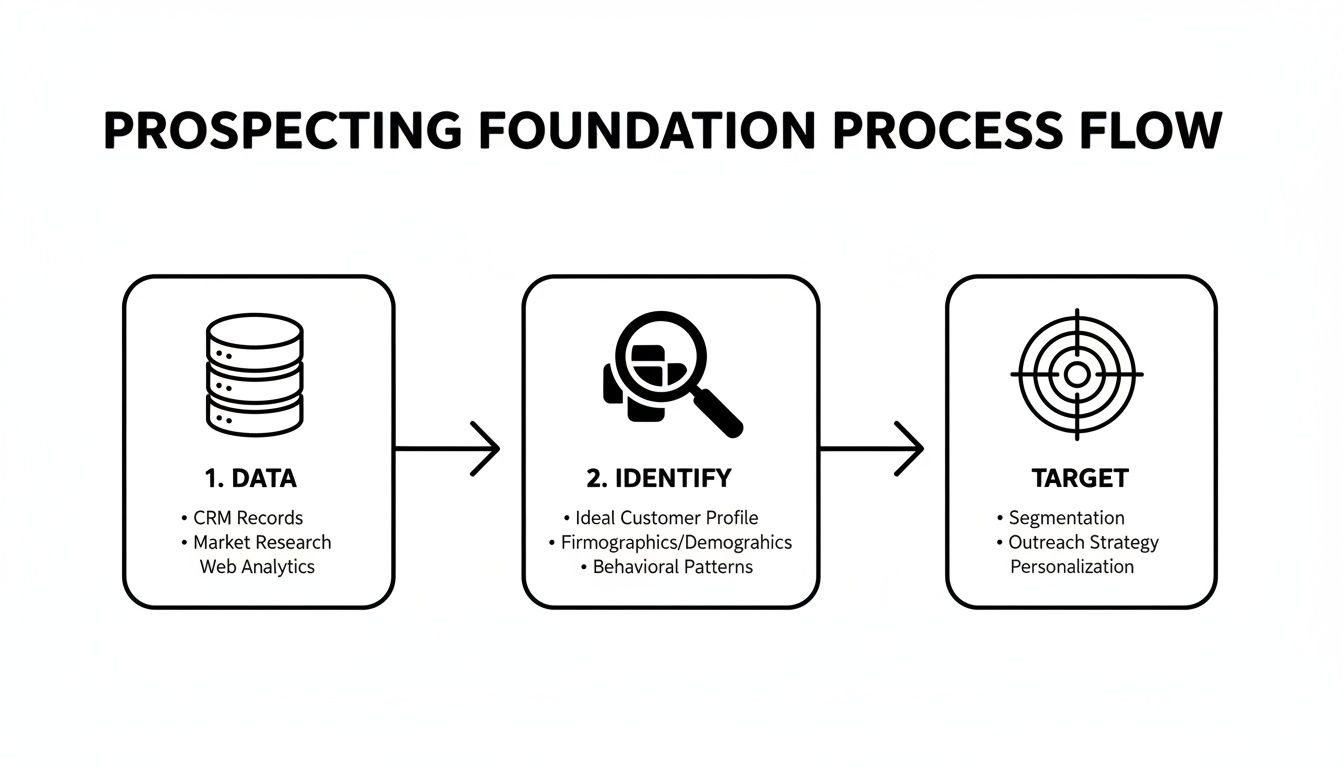
This simple flow drives home a critical point: without the right data and targeting, even the most brilliantly designed outreach cadence is dead on arrival.
The Psychology of an Effective Cadence
When it comes to prospecting, timing, frequency, and consistency are everything. A single call is easy to ignore. A persistent, professional sequence of contacts spread over a few weeks? That’s much harder to dismiss. The goal isn't to be annoying; it's to be politely persistent.
An effective outreach cadence recognizes that 80% of sales require five follow-up calls after the initial meeting, yet 44% of salespeople give up after just one follow-up. Persistence, when paired with value, is what separates top performers from everyone else.
This kind of persistence demonstrates your commitment and work ethic—exactly the qualities every seller wants in their agent. It shows you don't give up easily, which is precisely the kind of person they want negotiating the sale of their largest asset.
A Battle-Tested 14-Day Cadence Example
A structured cadence removes the guesswork. It tells you what to do and when, making sure no lead ever falls through the cracks. Here’s a simple but brutally effective 14-day sequence you can adapt for a motivated seller lead, like an expired listing or a pre-foreclosure.
Day 1:
- Morning (9 AM): Make that initial cold call. Your goal is simple: introduce yourself, state your value prop clearly, and ask for an appointment.
- Afternoon (1 PM): If you didn't connect, send a personalized email that references the call. Toss in a link to your LinkedIn profile or a quick video intro.
Day 3:
- Morning (10 AM): Time for your second call attempt, but at a different time of day. If it goes to voicemail, leave a concise, professional message.
- Immediately After Call: Fire off a brief SMS: "Hi [Name], just left you a quick voicemail regarding your property at [Address]. - [Your Name], [Brokerage]."
Day 5:
- Action: Drop a high-quality direct mail piece in the mail. This could be a handwritten note or a compelling postcard with a strong call-to-action. We break down some great strategies in our complete guide to direct mail marketing for real estate.
Day 7:
- Evening (6 PM): Third call attempt. This is often a great time to catch people after work. Be sure to reference the mailer they should have just received.
Day 10:
- Afternoon (2 PM): Send a follow-up email that provides real value, like a custom market report for their neighborhood or a blog post on "Common Mistakes Sellers Make."
Day 14:
- Morning (11 AM): Make your final call attempt. The tone here should be helpful, not pushy: "Hi [Name], I've tried to connect a few times to see if I could offer any help. If the timing just isn't right, no problem, just let me know."
- Action: If you still haven't made contact, it's time to move them into a long-term nurture campaign, like your monthly newsletter.
This structured approach ensures you make a professional impression, provide genuine value, and give yourself multiple shots at connecting without ever overwhelming the prospect.
Mastering Lead Qualification and Conversion
Getting people on the phone or to answer the door is just the first step. A steady stream of conversations is great, but let's be real—not every conversation turns into a commission check. This is where top-performing agents separate themselves from the pack. They’ve mastered the art of quickly and accurately qualifying leads.
This isn't about being pushy or blowing people off. It’s actually the opposite. It’s about respecting everyone's time, both yours and theirs, by focusing your energy where it's going to make a real difference.
The whole point of qualification is to figure out three things: a prospect’s motivation, their timeline, and their financial capacity. Without a solid process for digging into these details, you’ll find yourself spending weeks chasing down a “lead” who was never serious in the first place. A great qualification system is your filter. It separates the people who need you right now from the casual browsers who should go into a long-term nurture campaign.
This data-driven approach is more critical now than ever before. Real estate has become a 'speed-to-lead' game, and the average industry conversion rate is a sobering 4.7%. When so few inquiries actually close, the real advantage goes to the agent with a repeatable system for identifying the hottest leads and jumping on them immediately. You can dig deeper into real estate marketing statistics and their impact here.
The Key Qualification Questions You Need to Ask
Effective qualification means going deeper than just "Are you looking to buy or sell?" You're trying to understand their story, the real reasons behind a potential move. Think of it less like an interrogation and more like a friendly diagnosis.
Here are the essential areas to explore:
- Motivation: "So, what's prompting you to think about making a move?" This is the big one. It uncovers the why—a new job, a growing family, downsizing—which is the single best indicator of how serious they are.
- Timeline: "If everything lined up perfectly, when would you ideally like to be in your new home?" This simple question instantly sorts the "we're ready now" folks from the "maybe next year" crowd.
- Capacity (for Sellers): "Have you already spoken with a lender to get an idea of your options for your next purchase?" This helps you understand if they’re financially prepared and have a realistic game plan.
- Capacity (for Buyers): "Have you been pre-approved with a lender yet?" This is a non-negotiable. It confirms their actual buying power and separates serious shoppers from window shoppers.
- Agent Relationship: "Are you currently under contract with another real estate agent?" Asking this upfront is just good business. It respects industry ethics and saves you from wasting your time.
These questions are your toolkit. They help you build a clear picture of each prospect's situation so you can tailor your follow-up and serve them best.
Reading Between the Lines
Sometimes, what a prospect doesn't say is just as telling as what they do. With experience, you'll learn to pick up on the subtle cues that scream motivation—or a lack thereof. Listen to their tone, how specific their answers are, and how willing they are to discuss the next steps.
A motivated prospect will ask detailed questions about the process, talk openly about their finances, and be eager to schedule a meeting. A casual browser, on the other hand, will use vague phrases like "just looking" or "sometime in the future" and will shy away from any commitment.
For example, a prospect whose first question is about your commission rate is likely just shopping around for a discount. But someone who asks, "What are the first steps to get my home on the market?" is signaling genuine intent. Learning to spot these differences will make your prospecting time infinitely more productive.
Handling Common Objections with Confidence
Remember this: objections are not rejections. They're usually just requests for more information or a bit of reassurance. A calm, prepared response can turn a hesitant prospect into a committed client.
Here’s how to handle two of the most frequent objections you’ll hear:
Objection 1: "We're not ready just yet."
- Your Response: "I completely understand that timing is everything. Just so you can keep an eye on things without any pressure, would it be helpful if I set you up on a neighborhood alert? It's a great way to see what homes like yours are selling for."
- The Goal: You've validated their position, offered value without being pushy, and just earned permission to stay in touch. That's a win.
Objection 2: "We're thinking of selling For Sale By Owner."
- Your Response: "That's definitely an option a lot of people consider. My main goal is just to make sure you have all the information you need to make the best decision for your family. Would you be open to a quick 15-minute chat where I can share the net sheet from the last FSBO I helped? It might give you a different perspective."
- The Goal: You've skillfully sidestepped an argument. Instead, you've positioned yourself as a valuable resource and created a compelling, low-stakes reason for them to talk to you again.
How to Automate and Scale Your Prospecting Engine
Let's be honest: manual prospecting is a surefire way to burn out. The endless dialing, the messy spreadsheets, the follow-ups that slip through the cracks... it's not a sustainable way to build a business. It creates a feast-or-famine cycle that puts a hard cap on your growth.
To build a real, scalable business, you have to get beyond brute force. It's time to embrace technology that works for you, even when you’re not actively working.
The goal isn't just to buy a bunch of tools. It's about building an integrated system where your data, outreach, and lead management all talk to each other. We want to automate the repetitive grunt work that drains your time so you can focus on what you're best at: building relationships and closing deals. It's about creating a prospecting machine that runs in the background, consistently keeping your pipeline full.

Think of your CRM as the command center for your entire operation. A well-configured CRM is the foundation for everything else we're about to discuss.
Optimizing Your CRM for Prospecting
Your Customer Relationship Management (CRM) system has to be more than a digital Rolodex. It needs to be the engine powering your prospecting, actively managing leads and kicking off crucial follow-up tasks. Without setting it up properly, even the priciest CRM is just a glorified spreadsheet.
To turn your CRM into a high-performance machine, focus on these key areas:
- Lead Tagging and Segmentation: The moment a new lead comes in, tag it. Tag it based on the source (e.g., "Expired," "FSBO," "Tax Lien") and where they are in your process (e.g., "Hot," "Nurture," "Unresponsive"). This is non-negotiable. It’s what lets you send hyper-relevant, automated campaigns to specific groups instead of blasting everyone with the same generic message.
- Automated Workflow Triggers: This is where the magic happens. Set up "if-then" rules. For example, if a lead is tagged as "Hot," then the CRM automatically creates a task for you to call them within 24 hours. If a lead doesn't respond after three calls, then it triggers an automated email nurture sequence.
- Task Management and Reminders: Your CRM should automatically generate your daily call list. No more guesswork. It should be based on lead status and the last contact date, ensuring no one ever falls through the cracks. Considering that an estimated 70-75% of all listing appointments are set during follow-up, automated reminders are absolutely critical.
When you dial in these features, your CRM transforms from a passive database into an active assistant. It starts managing your pipeline for you. If you want to go deeper on this, our guide on marketing automation best practices is a great next step.
The Rise of the AI Inside Sales Agent
Okay, a well-tuned CRM automates tasks. But the next step in scaling your prospecting is automating the actual conversations. This is where AI-powered Inside Sales Agents (ISAs) are completely changing the game.
These are not your grandma's chatbots. We're talking about sophisticated AI systems designed to engage leads, ask qualifying questions, and book appointments 24/7. An AI ISA can handle the initial, time-consuming stages of lead engagement at a scale no human team could ever match.
Think about it: an AI can instantly respond to a new web lead at 2 AM, engage them in a natural text conversation, ask key qualifying questions, and book a qualified appointment directly into your calendar while you sleep.
This technology solves the "speed-to-lead" problem once and for all. Every single inquiry gets an immediate, intelligent response, which dramatically increases your conversion rates. More importantly, it frees up your time to focus only on meeting with warm, pre-qualified prospects who are actually ready to talk business.
Building an Integrated Workflow
The ultimate goal here is to create a seamless, hands-off system that connects your data, your AI, and your CRM. This integrated workflow takes every prospect on a smooth journey from initial contact to a booked appointment, with almost no manual work from you.
Here’s what that looks like in action:
- Data Ingestion: Your system automatically pulls in high-intent data—like new pre-foreclosure or probate filings—and feeds it directly into your CRM.
- AI Engagement: The second a new lead hits the system, the AI ISA is triggered. It kicks off contact via SMS or email, using a script tailored to that specific lead type.
- Automated Qualification: The AI engages the prospect in a real, two-way conversation. It asks your pre-defined qualifying questions about their motivation, timeline, and the property's condition.
- Appointment Setting: Once the AI identifies a motivated and qualified seller, it checks your calendar's availability and books an appointment right then and there.
- CRM Sync: The entire conversation transcript, along with the prospect's answers and the appointment details, is automatically logged in your CRM. You just get a notification with a full summary, prepped and ready for your meeting.
This kind of closed-loop system is the key to maximum efficiency. It eliminates manual data entry, guarantees instant follow-up, and delivers a predictable stream of qualified appointments. This is how you scale your prospecting efforts profitably.
Tracking KPIs for Predictable Pipeline Growth
Prospecting without tracking your numbers is like driving blind. Sure, you might be moving, but you have no clue if you're headed in the right direction. When you bring a data-driven approach to your prospecting, you transform it from a guessing game into a predictable, repeatable system for generating business.
If you don't measure it, you can't improve it. It's that simple.
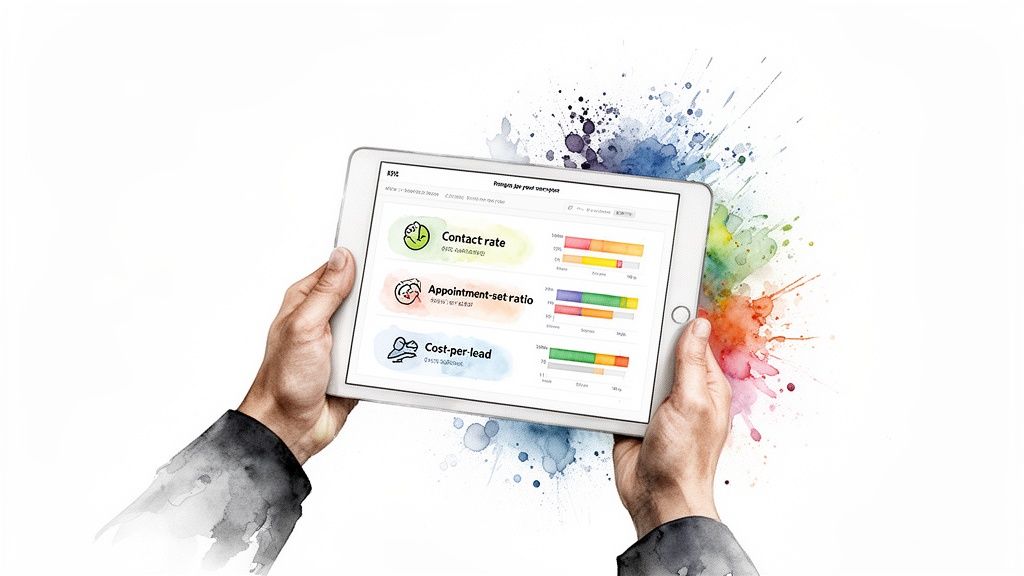
This is all about pinpointing the specific metrics—your Key Performance Indicators (KPIs)—that directly impact your bottom line. By keeping a close eye on these numbers, you can spot the weak links in your process, test new scripts with confidence, and make smart decisions that guarantee your hard work actually fills your pipeline.
Identifying Your Core Prospecting Metrics
You don't need a crazy-complicated dashboard with dozens of metrics flashing at you. To get started, just focus on the handful of KPIs that tell the most important story about the health of your prospecting efforts. These are the numbers that connect your daily grind (making calls, knocking doors) to your ultimate goal (closing deals).
The absolute must-track metrics for any agent are:
- Dials per Hour: This is a raw measure of your effort and efficiency. It tells you how good you are at just getting through your call list.
- Contact Rate: The percentage of your dials that result in a real, live conversation with a decision-maker. A low contact rate could mean you're calling at the wrong times or, more likely, your data is garbage.
- Appointment Set Rate: Out of the people you actually talk to, what percentage agrees to meet with you? This KPI is a direct reflection of your script's power and your ability to build rapport—fast.
- Cost Per Lead (CPL): Simple math: how much are you spending (on data, dialers, mailers) to generate one qualified lead? This is critical for figuring out which prospecting channels are actually profitable.
- Conversion Rate (Lead to Close): The big one. The ultimate measure of success—what percentage of your initial leads becomes a closed transaction and a commission check?
Tracking these numbers gives you a clear, objective view of what’s working and what’s a waste of time, allowing you to fine-tune your strategy on the fly.
To make this even more practical, here’s a quick rundown of the essential KPIs, how to calculate them, and what good looks like.
Essential Prospecting KPIs And Benchmarks
| Metric (KPI) | How to Calculate | Industry Benchmark | What It Tells You |
|---|---|---|---|
| Dials Per Hour | Total Dials / Total Hours Logged | 80-120+ (with a dialer) | Your raw activity level and workflow efficiency. Are you maximizing your time? |
| Contact Rate | (Total Contacts / Total Dials) * 100 | 5-10% (cold data) | The quality of your data and the timing of your calls. A low rate points to bad numbers or bad timing. |
| Appointment Set Rate | (Appointments Set / Total Contacts) * 100 | 2-5% | The effectiveness of your script, value proposition, and objection handling skills. This is a measure of your skill on the phone. |
| Cost Per Lead (CPL) | Total Prospecting Spend / Total Leads Generated | $50 - $300+ | The financial efficiency of a specific lead source. It helps you decide where to invest your marketing dollars. |
| Lead-to-Close Rate | (Closed Deals / Total Leads) * 100 | 1-3% | The overall health of your entire sales funnel, from initial contact to closing. This is the ultimate report card on your process. |
Remember, these benchmarks are just a starting point. Your own numbers are what matter most. The goal is consistent improvement over time.
Building a Simple Prospecting Dashboard
A dashboard doesn't have to be some fancy software. Honestly, a simple spreadsheet in Google Sheets or a basic report in your CRM works perfectly. The whole point is to have a single place where you can see your performance at a glance.
Just set up columns for each of your core KPIs. Then, add rows for each day or week so you can see how things are trending. This visual snapshot will quickly show you what's going on. For instance, you might see that your contact rate always tanks on Friday afternoons, which is your cue to shift that call block to a more productive time.
A well-maintained prospecting dashboard is more than just a reporting tool; it’s a diagnostic tool. It shows you exactly where your pipeline is leaking so you can patch the holes and improve your flow-through from conversation to closing.
This focus on systems is more important than ever. The market sentiment backs this up: nearly 65% of agents have a positive career outlook, but they consistently name a lack of qualified leads and low inventory as their biggest hurdles. This points to a huge demand for repeatable, data-backed systems that get predictable results in any market. You can dive deeper into what agents truly believe heading into 2026 in the full Agent Confidence Index report.
Using Data to Make Smarter Decisions
Once you're consistently tracking your KPIs, you can start using that data to make real strategic adjustments. This is where the magic happens.
For example, let's say your Contact Rate is great but your Appointment Set Rate is in the toilet. The problem isn't your data—it's your script. That’s your signal to A/B test a new opener or a different way of handling the "I'm not interested" objection. Track the performance of the new script versus the old one. The numbers will tell you who wins.
Likewise, if your Cost Per Lead for direct mail is double what it is for cold calling, but the Conversion Rate is identical, you know exactly where to double down on your investment. This kind of objective analysis removes emotion and guesswork from your business, empowering you to put your time and money where they will generate the highest possible return.
A Few Common Prospecting Questions
Even with the best playbook in hand, theory only takes you so far. When you're in the trenches, real-world questions pop up. Let's tackle some of the most frequent ones I hear from agents.
What Is The Best Day to Prospect in Real Estate?
There's no single magic bullet, but the data points to a clear trend: mid-week days (Tuesday, Wednesday, and Thursday) are your best bet. You'll find contact rates are consistently higher during this window.
Mondays are a wash for most people—they're just trying to dig out from the weekend. And by Friday, everyone's mentally checked out. Aim for the morning (8 AM to 10 AM) or late afternoon (4 PM to 6 PM). You'll either catch people before their day gets crazy or just as they're getting home. The real secret, though, is just blocking the time and showing up.
How Many Hours Should a Real Estate Agent Prospect?
If you're new and building your business from absolute zero, you need to put in the time. Plan on a solid 15 to 20 hours a week of pure prospecting. That's not optional; it's the cost of entry for building momentum and getting a steady stream of leads in the door.
For veteran agents with a strong referral base, you can often dial that back to a highly focused 5 to 10 hours per week. The key for everyone, new or established, is to treat that time like a listing appointment. It goes on the calendar, it's non-negotiable, and it happens every single week.
How Do You Get Your First Listing With No Experience?
Getting that first listing is a game of leverage. You trade your lack of a track record for pure, relentless energy and a smart strategy. Your first move should always be your Sphere of Influence (SOI)—that means friends, family, old co-workers. Make sure every single person you know is aware that you're in the business and hungry for work.
At the same time, you should be laser-focused on FSBOs and Expireds. These are homeowners who have already declared their intention to sell. You don't approach them as the market guru; you approach them as the dedicated, hardworking agent who will simply out-hustle everyone else to get their home sold. If you're looking for more ways to fill your pipeline, this ultimate guide to getting real estate listings is a fantastic resource.
Your biggest asset as a new agent is your work ethic. You have to sell your dedication, your around-the-clock availability, and the modern marketing tactics you'll deploy that some older agents might ignore.
Can You Cold Call for Real Estate?
Yes, absolutely. Cold calling is still one of the fastest and most direct ways to generate business, but you have to do it by the book. That means scrubbing every list you get against the National Do Not Call Registry. The fines are no joke, so don't even think about skipping this step.
The agents who win at cold calling have a tight script, a crystal-clear value proposition, and thick skin. Remember, the goal isn't to list a house on the first call. It's just to start a conversation and set an appointment. That's it.